MCQ
$PC{l_5}$ exists but $NC{l_5}$ does not because
  • Nitrogen has no vacant $d-$ orbitals
  • B
    $NC{l_5}$ is unstable
  • C
    Nitrogen atom is much smaller
  • D
    Nitrogen is highly inert

Answer

Correct option: A.
Nitrogen has no vacant $d-$ orbitals
(a) Nitrogen does not have vacant $‘d’-$ orbitals so it can’t have $+5$ oxidation state

i.e. the reason $PC{l_5}$ exists but $NC{l_5}$ does not.

Need a full question paper?

Generate a complete, print-ready paper with questions like this in minutes — across 16+ boards, with answer keys.

Start Generating Free

Similar questions

Mass of $NaOH$ required for formation of $100\, ml$ of its decimolar solution is .............. $\mathrm{g}$
The best evidence for the existence and movement of particles in liquids was provided by $ .......... :$
Among the following the correct statement($s$) for electrons in an atom is(are)

$(A)$ Uncertainty principle rules out the existence of definite paths for electrons.

$(B)$ The energy of an electron in $2 s$ orbital of an atom is lower than the energy of an electron that is infinitely far away from the nucleus.

$(C)$ According to Bohr's model, the most negative energy value for an electron is given by $n=1$, which corresponds to the most stable orbit.

$(D)$ According to Bohr's model, the magnitude of velocity of electrons increases with increase in values of $n$.
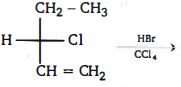
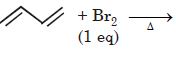
What is stereochemistry of product ?
The $K_{sp}$ of $Ag_2CrO_4, AgCl, AgBr$ and $AgI$ are respectively, $1.1 \times 10^{-12}, 1.8 \times 10^{-10},$$ 5.0 \times 10^{-13}, 8.3 \times 10^{-17}.$ Which one of the following salts will precipitate last if $AgNO_3$ solution is added to the solution containing equal moles of $NaCl, NaBr, NaI$ and $Na_2CrO_4$ ?
For the reaction $PC{l_3}_{(g)} + C{l_2}_{(g)}$ $\rightleftharpoons$ $PC{l_5}_{(g)}$ at ${250\,^o}C$, the value of ${K_c}$ is $26$, then the value of ${K_p}$ on the same temperature will be
An enantiomerically pure acid is treated with racemic mixture of an alcohol having one chiral carbon. The ester formed will be
$1g$ of $\ce{M_2CO_3}$ on treatment with excess $\ce{HCl}$ produces $0.01186$ moles of $\ce{CO_2}$ The molar mass of $\ce{M_2CO_3}$ in $\ce{g mor}^{-1}$ is :
major product is ?
Pure water is :