Question
People living in hilly regions usually suffer from simple goitre. Explain.

Answer

Iodine is essential for the production of thyroxin by the thyroid gland. The people living in hilly regions receive insufficient iodine in their diet, due to the fact that they drink iodine deficient water from rivers and streams fed by melting snow. Even their diet has little or no iodine. When there is a deficiency of iodine in the diet the thyroid gland enlarges in order to compensate for this deficiency resulting in goitre.

Need a full question paper?

Generate a complete, print-ready paper with questions like this in minutes — across 16+ boards, with answer keys.

Start Generating Free

Similar questions

Leaves of the sensitive plant wilt and droop down on a slight touch. What mechanism brings about this change?
The diagram alongside refers to an experiment in which the apparatus was set up with the light source 10 cm away from the plant. After 15 minutes the number of bubbles evolved per minute from the cut stem was recorded. The light source was moved to 20 cm away from the plant, left for 15 minutes and the number of bubbles evolved per minute was again recorded. The experiment was repeated with the light source at distances of 40, 60, 80 and 100 cm away from the plant. Plot a graph for the results obtained and answer the following questions.
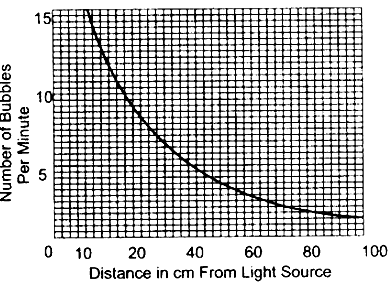
(i) From the graph it seems likely that the rate of bubbling per minute at 50 cm would have been
(a) 2.0 (b) 2.5 (c) 3.0 (d) 3.5
(ii) The gas produced by the plant during the experiment was
(a) air (b) oxygen (c) carbon dioxide (d) nitrogen (e) hydrogen
(iii) The gas collected comes due to the breakdown of
(a) glucose (b) starch (c) water (d) air (e) ATP
(iv) If ice cubes were added to the water, the rate of bubble formation would
(a) Stay the same.
(b) Increase because more water is added.
(c) Decrease because the temperature drops.
(d) Decrease because water freezes.
(e) Cannot tell from the information given.
(v) If some sodium bicarbonate is added to the water the rate of bubble formation
(a) Increases because more respiration occurs.
(b) Increases because more photosynthesis occurs.
(c) Increases because the gas becomes less soluble.
(d) Decreases because carbon dioxide acts as a limiting factor.
(e) Decreases because respiration decreases.
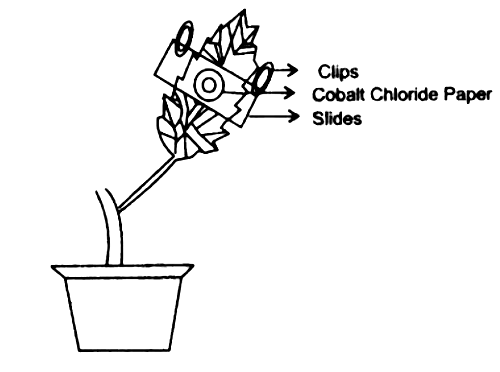
Given below is the diagram of an experimental set up to study the process of transpiration in plants. Study the same and then answer the questions that follow:

(i) What is the colour of dry cobalt chloride paper?
(ii) Is the experimental leaf a monocot or a dicot? Give a reason to support your answer.
(iii) Why axe glass slides placed over the dry cobalt chloride papers?
(iv) After about half an hour what change, if any, would you expect to find in the cobalt chloride paper placed on the dorsal and ventral sides of the leaf? Give a reason to support your answer.
(v) Define the term ‘transpiration’.
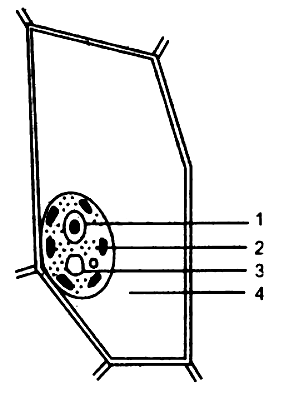
Given below is the diagram of a cell as seen under the microscope after having been placed in a solution:

(i) What is the technical term used for the state/condition of the cell given above?
(ii) Give the technical term for the solution in which the cell was placed.
(iii) Name the parts numbered 1 to 4.
(iv) Is the cell given above a plant cell or an animal cell ? Give two reasons in support of your answer as evident from the diagram.
(v) What would you do to bring this cell back to its original condition?
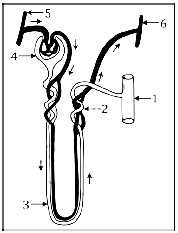
The given diagram represents a nephron and its blood supply. Study the diagram and answer the following questions:
(i) Label parts 1, 2, 3 and 4.
(ii) State the reason for the high hydrostatic pressure in the glomerulus.
(iii) Name the blood vessel which contains the least amount of urea in this diagram.
(iv) Name the two main stages of urine formation.
(v) Name the part of the nephron which lies in the renal medulla.
Photosynthesis in green plants is directly and indirectly dependent on so many plant structures.
Explain briefly the role of the following structures in this process is Xylem tissue in the leaf veins
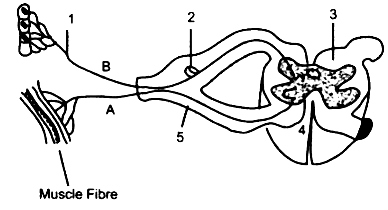
The diagram given below shows the internal structure of the spinal cord, depicting a simple reflex. Study the same and then answer the questions that follow:

(i) Name the parts numbered 1 to 5.
(ii) Using the letters of the alphabet shown in the figure indicate the direction in which an impulse enters and leaves the spinal cord.
(iii) What is the term given to the point of contact between two nerve cells?
(iv) What is meant by ‘simple reflex’ ? Give two examples of simple reflexes and name the stimuli too.
(v) How does the arrangement of nerve cells in the spinal cord differ from that in the brain?
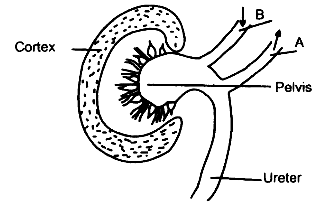
Given below is a simple diagram of the human kidney cut open longitudinally. Answer the following questions:
c
$(v)$ Write two differences in the composition of the blood flowing through blood vessels $A$ and $B.$
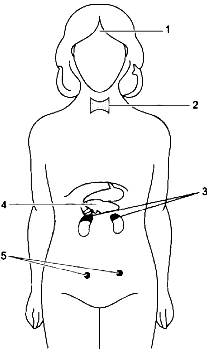
Given below is an outline of the human body showing the important glands.

(i) Name the glands marked 1 to 5.
(ii) Name the hormone secreted by 2. Give one important function of this hormone.
(iii) Name the endocrine cells present in part 3.
(iv) Name the hormone secreted by part 3. Give one important function of this hormone.
Sketch and label the human male reproductive system.