MCQ
Percentage of silver in German silver is
  • A
    $2\%$
  • B
    $1\%$
  • C
    $5\%$
  • $0\%$

Answer

Correct option: D.
$0\%$
d
(d)German silver is an alloy of copper not silver containing $Cu = 56.0\% $, $Zn = 24.0\% $and $Ni = 20.0\% $.

Need a full question paper?

Generate a complete, print-ready paper with questions like this in minutes — across 16+ boards, with answer keys.

Start Generating Free

Similar questions

Which of the following complex is paramagnetic, inner orbital complex and coloured
Aromatic primary amine when treated with cold $HN{O_2}$ gives
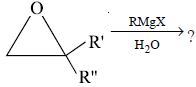
The products formed in the following reaction,$A$ and $B$ are 
When $100 \ mL$ of $1.0 \ M \ HCl$ was mixed with $100 \ mL$ of $1.0 \ M \ NaOH$ in an insulated beaker at constant pressure, a temperature increase of $5.7^{\circ} C$ was measured for the beaker and its contents (Expt. $1$). Because the enthalpy of neutralization of a strong acid with a strong base is a constant $\left(-57.0 \ kJ \ mol ^{-1}\right)$, this experiment could be used to measure the calorimeter constant. In a second experiment (Expt. $2$), $100 \ mL$ of $2.0 \ M$ acetic acid $\left(K_a=2.0 \times 10^{-5}\right)$ was mixed with $100 \ mL$ of $1.0 M \ NaOH$ (under identical conditions to Expt. $1$) where a temperature rise of $5.6^{\circ} C$ was measured.

(Consider heat capacity of all solutions as $4.2 J g ^{-1} K ^{-1}$ and density of all solutions as $1.0 \ g mL ^{-1}$ )

$1.$ Enthalpy of dissociation (in $kJ mol ^{-1}$ ) of acetic acid obtained from the Expt. $2$ is

$(A)$ $1.0$ $(B)$ $10.0$ $(C)$ $24.5$ $(D)$ $51.4$

$2.$ The $pH$ of the solution after Expt. $2$ is

$(A)$ $2.8$ $(B)$ $4.7$ $(C)$ $5.0$ $(D)$ $7.0$

Give the answer question $1$ and $2.$
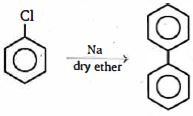
Above reaction is known as
Product Obtained is :
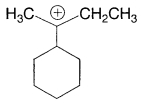
The total number of contributing structures showing hyperconjugation (involving $C - H$ bonds) for the following carbocation is
Given below are two statements :
Statement I : In Lassaigne's test, the covalent organic molecules are transformed into ionic compounds.
Statement II : The sodium fusion extract of an organic compound having N and S gives prussian blue colour with $FeSO _4$ and $Na _4\left[ Fe ( CN )_6\right]$In the light of the above statements, choose the correct answer from the options given below
For the reaction; $A + 2B\to C$, $5\,mole$ of $A$ and $8\,mole$ of $B$ will produce
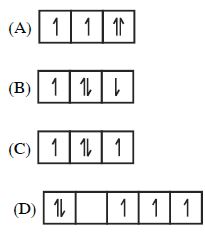
The portion of orbital diagrams representing the electronic configuration of certain elements shown below. Which of them violet Pauli’s Exclusion principle?