MCQ
$Ph - CH _{2}- CH = CH - CH _{3}$ $\xrightarrow[{{\text{(ii) }}Alc.\,KOH}]{{{\text{(i) B}}{{\text{r}}_2}}}$
  • A
    $Ph - CH = CH - CH = CH _{2}$
  • B
    $\begin{array}{*{20}{c}}
      {Ph - C{H_2} - CH - CH - C{H_3}} \\ 
      {\,\,\,\,\,\,\,\,\,\,\,|\,\,\,\,\,\,\,\,\,\,\,\,\,\,\,|\,\,\,} \\ 
      {\,\,\,\,\,\,\,\,\,\,\,\,\,\,\,\,OH\,\,\,\,\,OH\,\,\,} 
    \end{array}$
  • $Ph - CH _{2}- C \equiv C - CH _{3}$
  • D
    $Ph - C \equiv C - CH _{2}- CH _{3}$

Answer

Correct option: C.
$Ph - CH _{2}- C \equiv C - CH _{3}$
c
The final product formed is shown below:

$Ph - CH _{2}- CH = CH - CH _{3}$ $\xrightarrow{{(i)\,B{r_2}}}$$\begin{array}{*{20}{c}}
  {\,\begin{array}{*{20}{c}}
  {\,\,\,\,\,\,\,\,\,\,\,\,\,\,\,\,\,\,\,\,\,\,\,\,\,\,\,Br} \\ 
  {\,\,\,\,\,\,\,\,\,\,\,\,\,\,\,\,\,\,\,\,\,\,\,\,\,|} 
\end{array}} \\ 
  {Ph - C{H_2} - CH - CH - C{H_3}} \\ 
  {|\,\,\,\,\,\,} \\ 
  {Br\,\,\,} 
\end{array}$ $\xrightarrow[{ - 2HBr}]{{{\text{Alc}}{\text{. KOH}}}}$ $Ph - CH _{2}- C \equiv C - CH _{3}$

Need a full question paper?

Generate a complete, print-ready paper with questions like this in minutes — across 16+ boards, with answer keys.

Start Generating Free

Similar questions

The number of oxygen atoms in $4.4\, g$ of $C{O_2}$ is approx........ $\times {10^{23}}$.
Which of the following configurations represents atoms of the elements having the highest second ionization energy
The maximum and minimum melting point of first and second transition series elements respectively are obtained with
In alkaline hydrolysis of a tertiary alkyl halide by aqueous alkali if concentration of alkali is doubled, then the reaction
Which of the substances $Na,\,\,Hg,\,\,S,\,\,Pt$ and graphite can be used as electrodes in electrolytic cells having aqueous solutions
The substances used for the preparation of ether by Williamson's synthesis are
Which one of the following explains light both as a stream of particles and as wave motion
Given below are two statements: One is labelled as Assertion $A$ and the other is labelled as Reason $R$:

Assertion $A$ : The stability order of +$1$ oxidation state of $\mathrm{Ga}$, In and $\mathrm{Tl}$ is $\mathrm{Ga}<\mathrm{In}<\mathrm{Tl}$.

Reason $R$ : The inert pair effect stabilizes the lower oxidation state down the group.

In the light of the above statements, choose the correct answer from the options given below :

The rate of a gaseous reaction is given by the expression $K\,[A]\,[B]$. If the volume of the reaction vessel is suddenly reduced to $1/4^{th} $ of the initial volume, the reaction rate relating to original rate will be
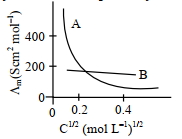
The molar conductivity for electrolytes $A$ and $B$ are plotted against $C^{1 / 2}$ as shown below. Electrolytes $A$ and $B$ respectively are: