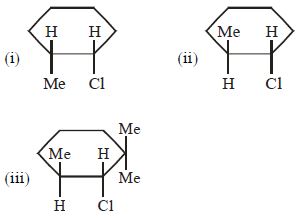
MCQ
$Ph-CH(OH)CH_3 \xrightarrow{{SOC{l_2}}}$ major product 
  • $\begin{array}{*{20}{c}}
    {Ph - CH - C{H_3}}\\
    {|\,\,\,\,\,\,\,\,\,\,}\\
    {Cl\,\,\,\,\,\,\,\,\,}
    \end{array}$
  • B
    $\begin{array}{*{20}{c}}
    {Ph - C{H_2} - C{H_2}}\\
    {\,\,\,\,\,\,\,\,\,\,\,\,\,\,\,\,\,\,\,\,\,\,\,\,\,\,\,\,\,\,|\,\,\,\,}\\
    {\,\,\,\,\,\,\,\,\,\,\,\,\,\,\,\,\,\,\,\,\,\,\,\,\,\,\,\,\,\,\,\,Cl\,\,\,\,}
    \end{array}$
  • C
    $Ph-CH_2-Cl$
  • D
    $\begin{array}{*{20}{c}}
    {Cl}\\
    |\,\,\,\,\\
    {Ph - C - C{H_3}}\\
    |\,\,\,\,\\
    {Cl\,\,}
    \end{array}$
Answer

Correct option: A.
$\begin{array}{*{20}{c}}
{Ph - CH - C{H_3}}\\
{|\,\,\,\,\,\,\,\,\,\,}\\
{Cl\,\,\,\,\,\,\,\,\,}
\end{array}$
a

Need a full question paper?

Generate a complete, print-ready paper with questions like this in minutes — across 16+ boards, with answer keys.

Start Generating Free

Similar questions

Which of the following is diamagnetic transitional metal ion
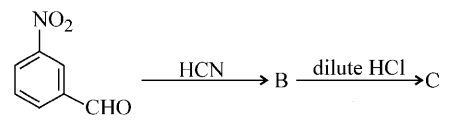
In the following reaction the product 'C' will be :
Image
Which is the correct reactivity order for $E_2$ reaction with alcoholic $KOH$ ?
Which has valency two
Which of the following is a first order reaction
In a set of reactions $m-$bromobenzoic acid gave a product $D.$ Identify the product $D.$

(image) $\xrightarrow{{SOC{l_2}}}\,B\,\xrightarrow{{N{H_3}}}\,C$$\,\xrightarrow[{B{r_2}}]{{NaOH}}\,D$

Tertiary alcohols $(3^\circ )$ having atleast four carbon atoms upon drastic oxidation yield carboxylic acid with
If freezing point of an aqueous urea solution is $271.14\,K$ at $1$ atmospheric pressure (if $K_f$ of water = $1.86\,K/m$) then what should be mole fraction of urea in this solution? (Freezing point of water is $273\,K$)
The freezing point of benzene decreases by $0.45^o C$ when $0.2\,g$ of acetic acid is added to $20\, g$ of benzene. If acetic acid associates to form a dimer in benzene, percentage association of acetic acid in benzene will be .......... $\%$

$(K_f $ for benzene $= 5.12 \,K\, kg\, mol^{-1})$

$2.7 \mathrm{Kg}$ of each of water and acetic acid are mixed, The freezing point of the solution will be $-\mathrm{x}^{\circ} \mathrm{C}$. Consider the acetic acid does not dimerise in water, nor dissociates in water $\mathrm{x}=$ . . . . . . . (nearest integer)

[Given : Molar mass of water $=18 \mathrm{~g} \mathrm{~mol}^{-1}$, acetic acid $=60 \mathrm{~g} \mathrm{~mol}^{-1}$ ]

${ }^{\mathrm{K}_{\mathrm{f}}} \mathrm{H}_2 \mathrm{O}: 1.86 \mathrm{~K} \mathrm{~kg} \mathrm{~mol}^{-1}$

$\mathrm{K}_{\mathrm{r}}$ acetic acid : $3.90 \mathrm{~K} \mathrm{~kg} \mathrm{~mol}^{-1}$

freezing point: $\mathrm{H}_2 \mathrm{O}=273 \mathrm{~K}$, acetic acid $=290 \mathrm{~K}$ ]