MCQ
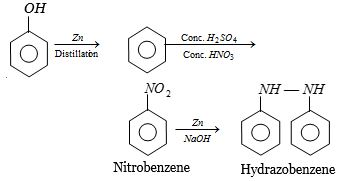
$\text{Phenol }\underset{\text{Distillation}}{\mathop{\xrightarrow{Zn}}}\,A\underset{\text{Conc}\text{. }HN{{O}_{3}}}{\mathop{\xrightarrow{\text{Conc}\text{. }{{H}_{2}}S{{O}_{4}}}}}\,B\underset{NaOH}{\mathop{\xrightarrow{Zn}}}\,C$   

In the above reaction  $A, B$  and $C $  are the following compounds

  • A
    ${C_6}{H_6},{C_6}{H_5}N{O_2}$ and aniline
  • B
    ${C_6}{H_6},$ dinitrobenzene and metanitroaniline
  • C
    Toluene, metanitrobenzene and metatoluedine
  • ${C_6}{H_6},\,{C_6}{H_5}N{O_2}$ and hydrazobenzene
Answer

Correct option: D.
${C_6}{H_6},\,{C_6}{H_5}N{O_2}$ and hydrazobenzene
d
(d)

Need a full question paper?

Generate a complete, print-ready paper with questions like this in minutes — across 16+ boards, with answer keys.

Start Generating Free

Similar questions

Reaction of $\ce{C_6H_5CH_2Br}$ with aqueous sodium hydroxide follows $........$
The compound $\mathrm{C}_{7} \mathrm{H}_{8}$ undergoes the following reactions:

$\mathrm{C}_{7} \mathrm{H}_{8} \stackrel{3 \mathrm{Cl}_{2} / \Delta}{\longrightarrow} \mathrm{A} \stackrel{\mathrm{Br}_{2} / \mathrm{Fe}}{\rightarrow} \mathrm{B} \stackrel{\mathrm{Zn} / \mathrm{HCl}}{\rightarrow} \mathrm{C}$

The product '$C$' is

The reaction of ozone with oxygen atoms in the presence of chlorine atoms can occur by a two step process shown below

${O_3}(g)\, + \,C{l^ * }(g)\, \to \,{O_2}(g) + Cl{O^ * }(g)$ ..... $(i)$               $[{K_i} = 5.2 \times {10^9}\,\,L\,mo{l^{ - 1}}\,{s^{ - 1}}]$

$Cl{O^ * }(g) + {O^ * }(g)\, \to \,{O_2}(g) + \,C{l^ * }(g)$ ..... $(ii)$                $[{K_{ii}} = 2.6 \times {10^{10}}\,\,L\,mo{l^{ - 1}}\,{s^{ - 1}}]$

The closest rate constant for the overall reaction 

${O_3}(g){\mkern 1mu}  + {\mkern 1mu} {O^*}(g){\mkern 1mu}  \to {\mkern 1mu} 2{O_2}(g)$ is  ........... $L\,\,mo{l^{ - 1}}\,{s^{ - 1}}$

Argyrol is a:
In the given reaction 

$\begin{array}{*{20}{c}}
  {O\,\,\,\,\,\,\,\,\,} \\ 
  {||\,\,\,\,\,\,\,\,\,\,} \\ 
  {C{H_3} - C{H_2} - C - C{H_2}COO{C_2}{H_5}} 
\end{array}\xrightarrow{{[X]\,}}(A)$$ \mathop {\xrightarrow{{(i)\,LiAl{H_4}\,}}}\limits_{(ii)\,{H_2}O/{H^ \oplus }} \begin{array}{*{20}{c}}
  {O\,\,\,\,\,\,\,\,\,} \\ 
  {||\,\,\,\,\,\,\,\,\,\,} \\ 
  {C{H_3} - C{H_2} - C - C{H_2} - C{H_2}OH} 
\end{array} + \,{C_2}{H_5}OH$

$[X]$ will be :

Following Sidgwick's rule of $EAN,$ $Co(CO)_x$ will be
An octahedral complex with the formula $\mathrm{CoCl}_3 \mathrm{nNH}_3$ upon reaction with excess of $\mathrm{AgNO}_3$ solution given 2 moles of $\mathrm{AgCl}$. Consider the oxidation state of Co in the complex is ' $x$ '. The value of " $\mathrm{x}+\mathrm{n}$ " is. . . . .
Vitamin $A$ is known as:
To get a $n-$type semiconductor from silicon, it should be doped with a substance with valence $......$
A first row transition metal with highest enthalpy of atomisation, upon reaction with oxygen at high temperature forms oxides of formula $\mathrm{M}_2 \mathrm{O}_{\mathrm{n}}$ (where $\mathrm{n}=3,4,5$ ). The 'spin-only' magnetic moment value of the amphoteric oxide from the above oxides is. . . . . . ..$\mathrm{BM}$ (near integer)

(Given atomic number: $\mathrm{Sc}: 21, \mathrm{Ti}: 22, \mathrm{~V}: 23$, $\mathrm{Cr}: 24, \mathrm{Mn}: 25, \mathrm{Fe}: 26, \mathrm{Co}: 27, \mathrm{Ni}: 28, \mathrm{Cu}: 29$, $\mathrm{Zn}: 30)$