MCQ
Phosphorus normally exhibits a covalency of:
  • $+3$ and $+5$
  • B
    $+2$ and $+3$
  • C
    $+1$ and $+2$
  • D
    $+3$ and $+4$

Answer

Correct option: A.
$+3$ and $+5$
Phosphorous acid $\ce{H_3PO_3},$ metaphosphorous acid $\ce{HPO_2}$​ has $+3$ oxidation state.
Pyrophosphoric acid $\ce{H_4P_2O_7}$​, orthophosphoric acid $\ce{H_3PO_4}$​ has $+5$ oxidation state.

Need a full question paper?

Generate a complete, print-ready paper with questions like this in minutes — across 16+ boards, with answer keys.

Start Generating Free

Similar questions

$\mathop {Z{n_{(s)}}|Z{n^{2 + }}_{(aq)}|}\limits_{{\rm{(anode)}}\,\,\,\,\,\,\,\,\,\,\,\,\,} |\mathop {C{u^{2 + }}_{(aq)}|C{u_{(s)}}}\limits_{{\rm{(cathode)}}\,\,\,\,\,\,\,\,\,\,\,\,\,\,\,} $is
The reaction $Z{n^{2 + }} + 2{e^ - } \to Zn$ has a standard potential of $ - 0.76\,V$. This means
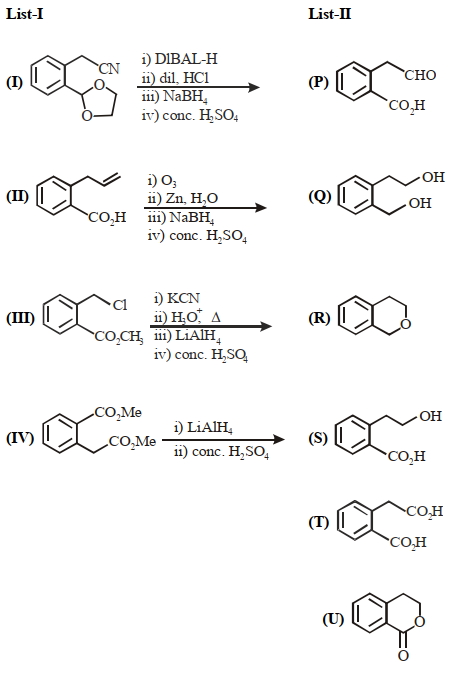
Answer the following by appropriately matching the lists based on the information given in the paragraph $List-I$ includess starting materials and reagents of selected chemical reactions. $List-II$ gives structures of compounds that may be formed as intermediate products and/or final products from the reactions of $List-I$

($1$) Which of the following options has correct combination considering $List-I$ and $List-II$?

$(1) (III), (S), (R)$ $(2) (IV), (Q), (R)$ $(3) (III), (T), (U)$ $(4) (IV), (Q), (U)$

($2$) Which of the following options has correct combination considering $List-I$ and $List-II$?

$(1) (I), (Q), (T), (U)$ $(2) (II), (P), (S), (U)$ $(3) (II), (P), (S), (T)$ $(4) (I), (S), (Q), (R)$

Give the answer quetion ($1$) and ($2$)
$C{u^ + }$ ion is not stable in aqueous solution because of disproportionation reaction. ${E^o}$ value for disproportionation of $C{u^ + }$ is .............. $\mathrm{V}$ (Given $E_{C{u^{2 + }}/C{u^ + }}^o = 0.15$, $E_{C{u^{2 + }}/Cu}^o = 0.34\,V$)
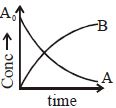
For the reaction, $A \to nB$. At the point of intersection of the two curves, the concentration of $B$ is given by .....
Metal used for making electric cable is:
$Br -CH_2 - (CH_2)_2 - CH_2 - Br + CH_3 NH_2 \to$ Product of the reaction is
Molar conductances of $BaCl_2,\,H_2SO_4$ and $HCl$ at infinite dilutions are $x_1,\, x_2$ and $x_3$ respectively. Equivalent conductance of $BaSO_4$ at infinite dilution will be
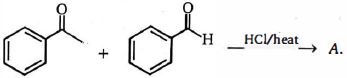
Product $( A)$ is
When $9.65$ coulombs of electricity is passed through a solution of silver nitrate (atomic weight of $Ag = 107.87$ taking as $108$) the amount of silver deposited is ............ $\mathrm{mg}$