MCQ
Photoelectric effect shows :
- ✓Particle-like behavior of light
- BWave-like behavior of light
- CBoth wave-like and particle-like behavior of light
- DNeither wave-like nor particle-like behavior of light
The photoelectric effect supports the particle theory of light because it shows that the energy required to release electrons from a metal is totally dependent upon the frequency of the light, and not the intensity.
Therefore, certain frequencies of light, no matter how intense, cannot cause an electron to be emitted from the surface of a metal.
Generate a complete, print-ready paper with questions like this in minutes — across 16+ boards, with answer keys.
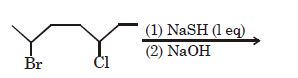
$(A)$ $\sigma$ orbital has a total of two nodal planes.
$(B)$ $\sigma^*$ orbital has one node in the $x z$-plane containing the molecular axis.
$(C)$ $\pi$ orbital has one node in the plane which is perpendicular to the molecular axis and goes through the center of the molecule.
$(D)$ $\pi^*$ orbital has one node in the $x y$-plane containing the molecular axis.
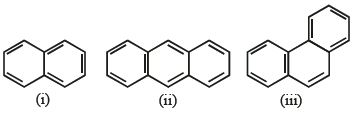
$Hex - 3 - ynal\xrightarrow[\begin{subarray}{l}
(ii)\,PB{r_3} \\
(i)\,Mg/ether \\
(i)\,C{O_2}/{H_3}{O^ + }
\end{subarray} ]{{(i)\,NaB{H_4}}}\,?$