MCQ
Photoelectric effect shows:
  • A
    Wave like behaviour of light.
  • Paritcle like behaviour of light.
  • C
    Both wavelike and paticle like behaviour.
  • D
    Neither wave like nor particle like behaviour of light.

Answer

Correct option: B.
Paritcle like behaviour of light.

Need a full question paper?

Generate a complete, print-ready paper with questions like this in minutes — across 16+ boards, with answer keys.
Start Generating Free

Similar questions

Maximum kinetic energy of the positive ion in the cyclotron is
A capacitor of capacitance $C$ is charged to potential difference $V_0$. Now this capacitor is connected to an ideal inductor. When $25\%$ of energy of capacitor is transferred to inductor then at that time what will be potential difference across capacitor
Laser beams are used to measure long distances because
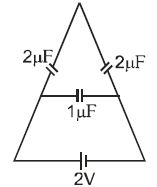
The charge (in $\mu C$) on any one of the $2\,\mu F$ capacitor and $1\,\mu F$capacitor will be given respectively as
Nuclear fission experiments show that the neutrons split the uranium nuclei into two fragments of about same size. This process is accompanied by the emission of several
For which gate output is high, if at least one input is low ?
The capacity of the parallel plate capacitor increases when:
A convex lens produces a real image m times the size of the object. What will be the distance of the object from the lens
Statement$-I :$ To get a steady de output from the pulsating voltage received from a full wave rectifier we can connect a capacitor across the output parallel to the load ${R}_{{L}}$

Statement$-II :$ To get a steady de output from the pulsating voltage received from a full wave rectifier we can connect an inductor in series with ${R}_{{L}}$.

In the light of the above statements, choose the most appropriate answer from the options given below:

The radius of hydrogen atom in its ground state is $5.3 \times {10^{ - 11}}m$. After collision with an electron it is found to have a radius of $21.2 \times {10^{ - 11}}m$. What is the principal quantum number $n$ of the final state of the atom $n=.........$