Question

Photon and electron are given same energy (. Wavelength associated with photon and electron are   and   then correct statement will be

(a) 

(b)  

(c)  

(d)  

Answer

(a) 

Need a full question paper?

Generate a complete, print-ready paper with questions like this in minutes — across 16+ boards, with answer keys.

Start Generating Free

Similar questions

Which of the following properties shows that light is a transverse wave?

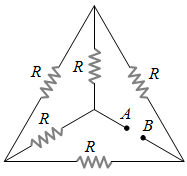
If each of the resistance of the network shown in the figure is R, the equivalent resistance between A and B is

(a) 5 R

(b) 3 R

(c) R 

(d) R/2

When the velocity of an electron increases, its de Broglie wavelength:

A diver at a depth of 12m in water (μ = 4/3) sees the sky in a cone of semi-vertical angle

(a)  

(b)

(c)

(d) 90°

A particle of mass m and charge q is placed at rest in a uniform electric field E and then released. The kinetic energy attained by the particle after moving a distance y  is

(a)  

(b)  

(c) qEy

(d )  

A spectral line λ = 5000 Å in the light coming from a distant star is observed as a 5200 Å. What will be recession velocity of the star

(a) 1.15  

(b) 1.15  

(c) 1.15  

(d) 1.15 km/sec

A table tennis ball which has been covered with conducting paint is suspended by a silk thread so that it hang between two plates, out of which one is earthed and other is connected to a high voltage generator. This ball

(a) Is attracted towards high voltage plate and stays there

(b) Hangs without moving

(c) Swing backward and forward hitting each plate in turn

(d) Is attracted to earthed plate and stays there

The angle of polarisation for any medium is 60o, what will be critical angle for this

(a)  

(b)  

(c)  

(d)  

The time period of a particle in simple harmonic motion is equal to the time between consecutive appearances of the particle at a particular point in its motion. This point is:
  1. The mean position.
  2. An extreme position.
  3. Between the mean position and the positive extreme.
  4. Between the mean position and the negative extreme.

A piece of semiconductor is connected in series in an electric circuit. On increasing the temperature, the current in the circuit will

(a) Decrease

(b) Remain unchanged

(c) Increase

(d) Stop flowing