MCQ
Phylum that doesn't have a true coelom is:
- APlatyhelminthes.
- BAnnelida.
- CEchinoderms.
- DArthropoda.
Generate a complete, print-ready paper with questions like this in minutes — across 16+ boards, with answer keys.
|
Column $-I$ |
Column $-II$ |
Column $-III$ |
|
$X.$ $RBC$ |
$P.$ Nucleated |
$A.$ $5-5.5$ Million |
|
$Y.$ Monocytes |
$Q.$ granulocyte |
$B.$ $2-3\%$ |
|
$Z.$ Eosinophil |
$R.$ Lack of nucleus |
$C.$ $6-8\%$ |
|
|
$S.$ Lack of $Hb$ |
$D.$ $20-25\%$ |
$a -$ cell cycle can vary from organisation to organism and also from cell type to cell type.
$b -$ $DNA$ synthesis occurs only in pachytene.
$c-G_1$ phase corresponds to the interval between mitosis and initiation of $DNA $ reproduction.
$A$. Concerned with lipid and steroidal hormone synthesis
$B$. Outer non-living rigid structure which gives shape to the cell and protects from mechanical damage and infection.
$C$. Both lie perpendicular to each other and each has an organisation like the cart wheel.
$D$. Responsible for trapping light energy for the synthesis of sugar.
$E$. Present in cells actively involved in protein synthesis and secretion.
$F$. Spherical structures, rich in hydrolytic enzymes.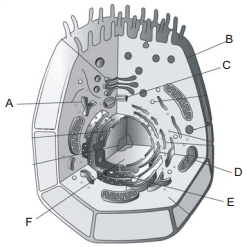
$(i)$ It causes potato spindle tuber disease.
$(ii)$ It has free $RNA.$
$(iii)$ Molecular weight of $RNA$ is low. Identify the infections agent.