MCQ
Physical independence of force is a consequence of:
  • A
    Third law of motion.
  • B
    Second law of motion.
  • First law of motion.
  • D
    All of these laws.

Answer

Correct option: C.
First law of motion.

Need a full question paper?

Generate a complete, print-ready paper with questions like this in minutes — across 16+ boards, with answer keys.
Start Generating Free

Similar questions

For angles of projection of a projectile at angle $(45^o  +\theta)$ and $(45^o  -\theta ) $ , the horizontal range described by the projectile are in the ratio of 
A piece of ice (heat capacity $=$ $2100$ $J kg^{-1}$ $^o C^{-1}$ and latent heat $=$ $3.36$ $×$ $10^5$ $J kg^{-1}$) of mass $m$ grams is at $-5^o C$ at atmospheric pressure. It is given $420$ $J$ of heat so that the ice starts melting. Finally when the ice-water mixture is in equilibrium, it is found that $1$ $gm$ of ice has melted. Assuming there is no other heat exchange in the process, the value of $m$ is ...... $gm$
A second harmonic has to be generated in a string of length $l$ stretched between two rigid supports. The points where the string has to be plucked and touched are respectively
Two particle of masses $1\,kg$ and $3\,kg$ have position vector $2\hat i + 3\hat j + 4\hat k$ and $ - 2\hat i + 3\hat j - 4\hat k$ respectively. The centre of mass has a position vector
The specific heat at constant pressure and at constant volume for an ideal gas are ${C_p}$ and ${C_v}$ and its adiabatic and isothermal elasticities are ${E_\varphi }$ and ${E_\theta }$ respectively. The ratio of ${E_\varphi }$ to ${E_\theta }$ is
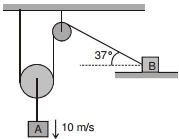
Find velocity of block ' $B$ ' at the instant shown in figure $........\,m/s$
If a liquid neither falls nor rise in a capillary tube, then the angle of contact between the liquid and the capillary material will be:
The gravitational potential energy of a system consisting of two particles separated by a distance $r$ is:
A monatomic ideal gas undergoes a process in which the ratio of $\mathrm{P}$ to $\mathrm{V}$ at any instant is constant and equals to $1$. What is the molar heat capacity of the gas?
If T is the total time of flight, $h$ is the maximum height $ \& R$ is the range for horizontal motion, the $x$ and $y$ co-ordinates of projectile motion and time $t$ are related as