MCQ
Pick the correct name of $[Co{(N{H_3})_5}Cl]C{l_2}$
  • A
    Chloropentammine cobalt $(III)$ 
  • B
    Pentammine cobalt $ (III) $ chloride
  • Chloropentammine cobalt $(III) $ chloride
  • D
    Chloropentammine cobalt $(II)$  chloride

Answer

Correct option: C.
Chloropentammine cobalt $(III) $ chloride
c
It’s obvious.

Need a full question paper?

Generate a complete, print-ready paper with questions like this in minutes — across 16+ boards, with answer keys.
Start Generating Free

Similar questions

The solubility product of $PbC{l_2}$ at ${20\,^o}C$ is $1.5 \times {10^{ - 4}}.$ Calculate the solubility
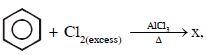
$x$ is 
$\left[ {Co{{\left( {N{H_3}} \right)}_5}N{O_2}} \right]C{l_2}$ and $\left[ {Co{{\left( {N{H_3}} \right)}_5}\left( {ONO} \right)} \right]C{l_2}$ are related to each other as
For the non-stoichiometric reaction $2A + B \to C + D,$ the following kinetic data were  obtained in three separate experiments, all at $298\,K$.

Initial Conc.
 $(A)$
Initial Conc.
 $(B)$

Initial rate of
formation of $C\,(mol\, L^-S^-)$

$0.1\,M$ $0.1\,M$ $1.2 \times 10^{-3}$
$0.1\,M$ $0.2\,M$ $1.2 \times 10^{-3}$
$0.2\,M$ $0.1\,M$ $2.4 \times 10^{-3}$

For the reaction the rate of formation of $C$ will be

Ionisation depends upon
Assertion : Acetylene on treatment with alkaline $KMnO_4$ produces acetaldehyde.
Reason : Alkaline $KMnO_4$ is a reducing agent.
When glycerine is added to a litre of water which of the following behaviour is observed
The current in a given wire is $1.8 \,A$. The number of coulombs that flow in $1.36$ minutes will be ............ $\mathrm{C}$
Using the data provided, calculate the multiple bond energy $\left( kJ mol ^{-1}\right)$ of a $C \equiv C$ bond $C _2 H _2$. That energy is (take the bond energy of a $C - H$ bond as $350 \ kJ \ mol ^{-1}$ )

$2 C ( s )+ H _2( g ) \longrightarrow C _2 H _2( g ) \ \ \ \ \  \Delta H =225 \ kJ mol ^{-1} $

$2 C ( s ) \longrightarrow 2 C ( g )\ \ \ \ \ \ \Delta H =1410 \ kJ mol ^{-1} $

$H _2( g ) \longrightarrow 2 H ( g ) \ \ \ \ \ \  \Delta H =330 \ kJ mol ^{-1}$
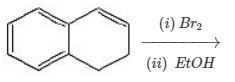
The major product of the following reaction is