MCQ
Pick the correct statements:
  • A
    Average speed of a particle in a given time is never less than the magnitude of the average velocity.
  • B
    It is possible to have a situation in which $\Big|\frac{\text{d}\vec{\text{v}}}{\text{dt}}\Big|\neq0$ but $\frac{\text{d}}{\text{dt}}|\vec{\text{v}}|=0.$
  • C
    The average velocity of a particle is zero in a time interval. It is possible that the instantaneous velocity is never zero in the interval.
  • All of the above

Answer

Correct option: D.
All of the above
  1. Average speed of a particle in a given time is never less than the magnitude of the average velocity.
  2. It is possible to have a situation in which $\Big|\frac{\text{d}\vec{\text{v}}}{\text{dt}}\Big|\neq0$ but $\frac{\text{d}}{\text{dt}}|\vec{\text{v}}|=0.$
  3. The average velocity of a particle is zero in a time interval. It is possible that the instantaneous velocity is never zero in the interval.
Example, the motion of a particle on a circular track with a constant speed.
Average velocity $=\frac{\text{Displacement}}{\text{Total time}}$
$\text{Displacement}\leq\text{Distance}$
$\therefore\text{Average velocrty}\leq\text{Average speed}$
In uniform circular motion, speed is constant but velocity is not.
$\text{i.e.},\Big|\frac{\text{d}\vec{\text{v}}}{\text{dt}}\Big|\neq0$ but $\frac{\text{d}}{\text{dt}}=|\vec{\text{v}}|=0$ which proves case $(b)$
  1. In one complete circle of uniform motion, average velocity is zero. Instantaneous velocity is never zero in the interval.

Need a full question paper?

Generate a complete, print-ready paper with questions like this in minutes — across 16+ boards, with answer keys.

Start Generating Free

Similar questions

The diameter of an air bubble which was initially $2\,mm$, rises steadily through a solution of density $1750\,kg\,m\,m ^{-3}$ at the rate of $0.35\,cms ^{-1}$. The coefficient of viscosity of the solution is poise (in nearest integer). (the density of air is negligible).
A charged particle moves in a gravity$-$free space without change in velocity. Which of the following is are possible:
  1. $\text{E}=0,\ \text{B}=0$
  2. $\text{E}=0,\ \text{B}\not=0$
  3. $\text{E}\not=0,\ \text{B}=0$
  4. $\text{E}\not=0,\ \text{B}\not=0$
A physical quantity $\vec{S}$ is defined as $\vec{S}=(\vec{E} \times \vec{B}) / \mu_0$, where $\vec{E}$ is electric field, $\vec{B}$ is magnetic field and $\mu_0$ is the permeability of free space. The dimensions of $\vec{S}$ are the same as the dimensions of which of the following quantity (ies)?

$(A)$ $\frac{\text { Energy }}{\text { charge } \times \text { current }}$

$(B)$ $\frac{\text { Force }}{\text { Length } \times \text { Time }}$

$(C)$ $\frac{\text { Energy }}{\text { Volume }}$

$(D)$ $\frac{\text { Power }}{\text { Area }}$

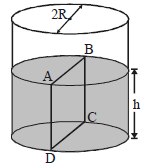
Water is filled up to a height $h$ in a beaker of radius $R$ as shown in the figure. The density of water is $\rho$, the surface tension of water is $T$ and the atmospheric pressure is $P_0$. Consider a vertical section $ABCD$ of the water column through a diameter of the beaker. The force on water on one side of this section by water on the other side of this section has magnitude
Latent heat of $1\,gm $ of steam is $536 \,cal/gm,$ then its value in $joule/kg$ is
The kinetic energy per gm mol for a diatomic gas at room temperature is
A man fires a bullet of mass $200 \,g$ at a speed of $5 \,m/s$. The gun is of one $kg$ mass. by what velocity the gun rebounds backwards ........ $m/s$
Read the following statements:

$A.$ When small temperature difference between a liquid and its surrounding is doubled the rate of loss of heat of the liquid becomes twice.

$B.$ Two bodies $P$ and $Q$ having equal surface areas are maintained at temperature $10^{\circ}\,C$ and $20^{\circ}\,C$. The thermal radiation emitted in a given time by $P$ and $Q$ are in the ratio $1: 1.15$

$C.$ A carnot Engine working between $100\,K$ and $400\,K$ has an efficiency of $75 \%$

$D.$ When small temperature difference between a liquid and its surrounding is quadrupled, the rate of loss of heat of the liquid becomes twice.

Choose the correct answer from the options given below :

A bar magnet is moved along the axis of a copper ring placed far away from the magnet, Looking from the side of the magnet an anticlockwise current is found to be induced in the ring. Which of the following may be true?
$A$ hollow sphere of radius $R$ and mass $m$ is fully filled with water of mass $m$. It is rolled down a horizontal plane such that its centre of mass moves with a velocity $v$. If it purely rolls