MCQ
Picric acid is (at ${25\,^o}C$)
- AA white solid
- BA colourless liquid
- CA gas
- ✓A bright yellow solid
Generate a complete, print-ready paper with questions like this in minutes — across 16+ boards, with answer keys.
$(I)$ Strong field ligand $(II)$ Weak field ligand
$(III)$ Mixed field ligand $(IV)$ Chelated ligand field
Choose the correct code
(IMAGE)
$[A]$ ( $M$ and $O)$ and ( $N$ and $P$ ) are two pairs of diastereomers
$[B]$ Bromination proceeds through trans-addition in both the reactions
$[C]$ $O$ and $P$ are identical molecules
$[D]$ (M and $O)$ and ( $N$ and $P)$ are two pairs of enantiomers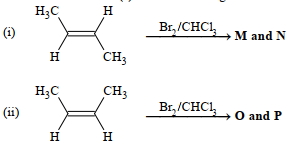
$1.$ The metal rod ${M}$ is
$(A)$ $\mathrm{Fe}$ $(B)$ $\mathrm{Cu}$ $(C)$ $\mathrm{Ni}$ $(D)$ $\mathrm{Co}$
$2.$ The compound ${N}$ is
$(A)$ $\mathrm{AgNO}_3$ $(B)$ $\mathrm{Zn}\left(\mathrm{NO}_3\right)_2$
$(C)$ $\mathrm{Al}\left(\mathrm{NO}_3\right)_3$ $(D)$ $\mathrm{Pb}\left(\mathrm{NO}_3\right)_2$
$3.$ The final solution contains
$(A)$ $\left[\mathrm{Pb}\left(\mathrm{NH}_3\right)_4\right]^{2+}$ and $\left[\mathrm{CoCl}_4\right]^{2-}$
$(B)$ $\left[\mathrm{Al}\left(\mathrm{NH}_3\right)_4\right]^{3+}$ and $\left[\mathrm{Cu}\left(\mathrm{NH}_3\right)_4\right]^{2+}$
$(C)$ $\left[\mathrm{Ag}\left(\mathrm{NH}_3\right)_2\right]^{+}$and $\left[\mathrm{Cu}\left(\mathrm{NH}_3\right)_4\right]^{2+}$
$(D)$ $\left[\mathrm{Ag}\left(\mathrm{NH}_3\right)_2\right]^{+}$and $\left[\mathrm{Ni}\left(\mathrm{NH}_3\right)_6\right]^{2+}$
Give the answer question $1,2$ and $3.$