MCQ
Plane angle and solid angle have :
  • A
    Dimensions but no units
  • B
    No units and no dimensions
  • C
     Both units and dimensions
  • Units but no dimensions

Answer

Correct option: D.
Units but no dimensions
d
Plane angle and solid angle are dimensionless but have units.

Need a full question paper?

Generate a complete, print-ready paper with questions like this in minutes — across 16+ boards, with answer keys.
Start Generating Free

Similar questions

A stone of mass m is tied to a string and is moved in a vertical circle of radius $ r$ making n revolutions per minute. The total tension in the string when the stone is at its lowest point is
Which of the following is dimensionally incorrect?
A particle of mass ${m}$ is suspended from a ceiling through a string of length $L$. The particle moves in a horizontal circle of radius $r$ such that ${r}=\frac{{L}}{\sqrt{2}}$. The speed of particle will be:
Given that $\vec A\, + \,\vec B\, = \,\vec C\,.$  If  $\left| {\vec A} \right|\, = \,4,\,\,\left| {\vec B} \right|\, = \,5\,\,$ and $\left| {\vec C} \right|\, =\,\sqrt {61}$ the angle between $\vec A\,\,$ and $\vec B$ is ....... $^o$
A block of mass m is placed on a smooth inclined plane of inclination $\theta$ with the horizontal. The force exerted by the plane on the block has a magnitude:
Suppose a container ia evacuated to leave just one molecule of a gas in it. Let $V_a$ and $v_{rms}$ represent the average speed and the $\text{rms}$ speed of the gas.
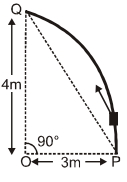
Consider an elliptically shaped rail $P Q$ in the vertical plane with $O P=3 \ m$ and $OQ =4 \ m$. A block of mass $1 \ kg$ is pulled along the rail from $P$ to $Q$ with a force of $18 \ N$, Which is always parallel to line $PQ$ (see the figure given). Assuming no frictional losses, the kinetic energy of the block when it reaches $Q$ is $(n \times 10)$ joules. The value of $n$ is (take acceleration due to gravity $=10 \ ms ^{-2}$ )
A body is in pure rotation. The linear speed $\nu$ of a particle, the distance r of the particle from the axis and the angular velocity $\omega$ of the body are related as $\omega=\frac{\text{v}}{\text{r}}$ Thus:
$10\, gm$ of ice at $-20°C$ is dropped into a calorimeter containing $10\, gm$ of water at $10°C;$ the specific heat of water is twice that of ice. When equilibrium is reached, the calorimeter will contain
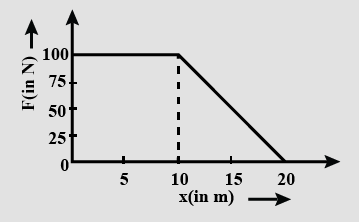
A force $F$ acting on an object varies with distance $x$ as shown in the figure. The work done by the force in moving the object from $x = 0$ and $x = 20m$ is: