Question
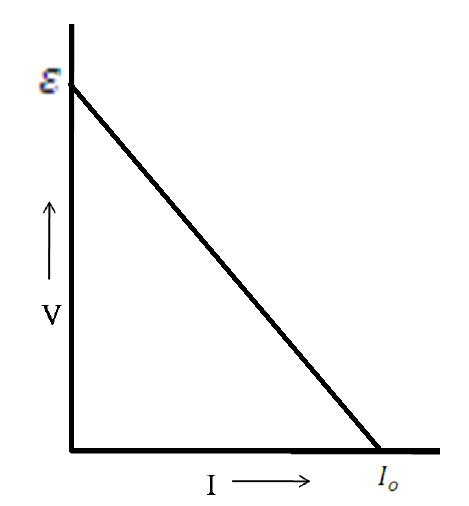
  1. Plot a graph showing variation of voltage vs the current drawn from the cell. How can one get information from this plot about the emf of the cell and its internal resistance?
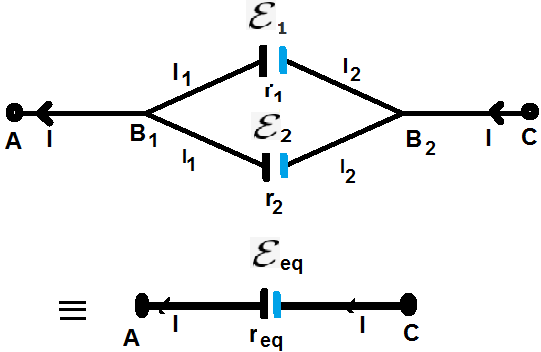
  2. Two cells of emf’s $E_1$ and $E_2$ and internal resistance $r_1$ and $r_2$ are connected in parallel. Obtain the expression for the emf and internal resistance of a single equivalent cell that can replace this combination?
Answer

  1.  

$V=\varepsilon-Ir$
When current is zero (I = 0), $\text{V}=\in$
And when V = 0, $\text{I}=\text{I}_0,\text{ }r=\frac{\in}{I_0}$
  1.  

$\text{V}=\text{V}(\text{B}_1)-\text{V}(\text{B}_2)=\varepsilon_1-I_1r_1$
$\text{V}=\text{V}(\text{B}_1)-\text{V}(\text{B}_2)=\varepsilon_2-I_2r_2$
$I=I_1+I_2$
$=​​​​​\frac{​\varepsilon_1-\text{V}}{r_1}+\frac{​\varepsilon_2-\text{V}}{r_2}=\Big(\frac{​\varepsilon_1}{r_1}+\frac{\varepsilon_2}{r_2}\Big)-\text{V}\Big(\frac{1}{r_1}+\frac{1}{r_2}\Big)$
$\text{V}=\frac{\varepsilon_1r_2+\varepsilon_2r_1}{r_1+r_2}-I\frac{r_1r_2}{r_1+r_2}$
On comparing with
$\text{V}=\varepsilon_{eq}-Ir_{eq}$
we get
$\varepsilon_{eq}=\frac{\varepsilon_1r_2+\varepsilon_2r_1}{r_1+r_2}$
$r_{eq}=\frac{r_1r_2}{r_1+r_2}$
Alternate Answer
A student may write the last two results in the following form.
$\frac{1}{r_{eq}}=\frac{1}{r_1}+\frac{1}{r_2}$
$\frac{\varepsilon_{eq}}{r_{eq}}=\frac{\varepsilon_1}{r_1}+\frac{\varepsilon_2}{r_2}$

Need a full question paper?

Generate a complete, print-ready paper with questions like this in minutes — across 16+ boards, with answer keys.

Start Generating Free

Similar questions

A small plane area is rotated in an electric field. In which orientation of the area is the flux of electric field through the area maximum? In which orientation is it zero?
A compound microscope consists of an objective lens of focal length $2.0 \ cm$ and an eyepiece of focal length $6.25 \ cm$ separated by a distance of $15 \ cm$. How far from the objective should an object be placed in order to obtain the final image at
$a$ .the least distance of distinct vision $(25 \ cm),$ and
$b$. at infinity?
What is the magnifying power of the microscope in each case?
An X-ray tube operates at 40kV. Suppose the electron converts 70% of its energy into a photon at each collision. Find the lowest there wavelengths emitted from the tube. Neglect the energy imparted to the atom with which the electron collides.
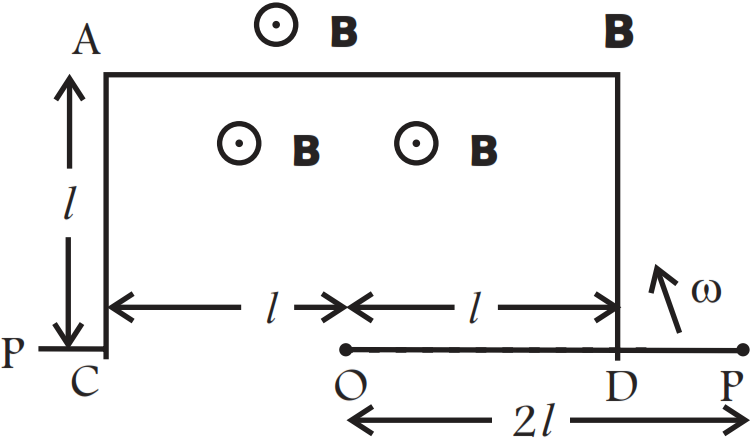
ODBAC is a fixed rectangular conductor of negilible resistance (CO is not connnected) and OP is a conductor which rotates clockwise with an angular velocity $\omega$ (Fig). The entire system is in a uniform magnetic field B whose direction is along the normal to the surface of the rectangular conductor ABDC. The conductor OP is in electric contact with ABDC. The rotating conductor has a resistance of $\lambda$ per unit length. Find the current in the rotating conductor, as it rotates by 180º.
The magnitude F of the force between two straight parallel current carrying conductors kept at a distance d apart in air is given by:
$\text{F}=\frac{\mu_0\text{I}_1\text{I}_2}{2\pi\text{d}}$
Where $I_1$ and $I_2$ are the currents flowing through the two wires.
Use this expression, and the sign convention that the:
“Force of attraction is assigned a negative sign and Force of repulsion is assigned a positive sign”.
Draw graphs showing dependence of F on:
  1. $I_1 I_2 $ when d is kept constant.
  2. d when the product $I_1 I_2$ is maintained at a constant positive value.
  3. d when the product $I_1 I_2$ is maintained at a constant negative value.
A uniform metre stick of mass 200g is suspended from the ceiling through two vertical strings of equal lengths fixed at the ends. A small object of mass 20g is placed on the stick at a distance of 70cm from the left end. Find the tensions in the two strings.
Is it possible that in a Coolidge tube characteristic $\text{L}_\alpha$ X-rays are emitted but not $\text{K}_\alpha$ X-rays?
A small object is placed at the centre of the bottom of a cylindrical vessel of radius 3cm and height 4cm filled completely with water. Consider the ray leaving the vessel through a corner. Suppose this ray and the ray along the axis of the vessel are used to trace the image. Find the apparent depth of the image and the ratio of real depth to the apparent depth under the assumptions taken. Refractive index of water = 1.33
A particle is fired vertically upward with a speed of 15km/s. With what speed will it move in intersteller space. Assume only earth's gravitational field.
A long wire carrying a current i is bent to form a plane angle $\alpha.$ Find the magnetic field B at a point on the bisector of this angle situated at a distance x from the vertex.