Question
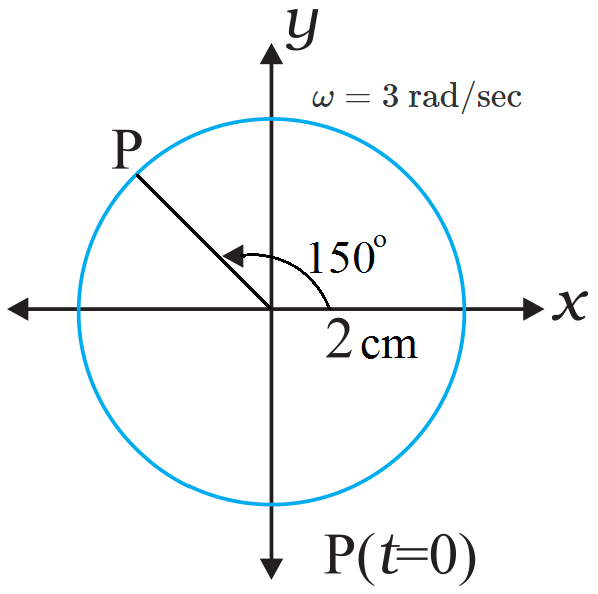
Plot the corresponding reference circle for each of the following simple harmonic motions. Indicate the initial (t = 0) position of the particle, the radius of the circle, and the angular speed of the rotating particle. For simplicity, the sense of rotation may be fixed to be anticlockwise in every case: (x is in cm and t is in s).$\text{x}=-2\sin\Big(3\text{t}+\frac{\pi}{3}\Big)$
Answer

$\text{x}=-2\sin\Big(3\text{t}+\frac{\pi}{3}\Big)=+2\cos\Big(3\text{t}+\frac{\pi}{3}+\frac{\pi}{2}\Big)$$=2\cos\Big(3\text{t}+\frac{5\pi}{6}\Big)$
If this equation is compared with the standard SHM equation $\text{x}=\text{A}\cos\bigg(\Big(\frac{2\pi}{\text{T}}\Big)\text{t}+\phi\bigg),$ then we get:
Amplitude, A = 2cm
Phase angle, $\phi=\frac{5\pi}{6}=150^\circ$
Angular velocity, $\omega=\frac{2\pi}{\text{T}}=3\text{rad/sec.}$
The motion of the particle can be plotted as shown in the following figure.

Need a full question paper?

Generate a complete, print-ready paper with questions like this in minutes — across 16+ boards, with answer keys.

Start Generating Free

Similar questions

Define the terms resultant or equivalent of two forces. Two forces $F_1$ and $F_2$ acting at an angle $\theta$ on a body simultaneously have a resultant F. Show that $\theta=\cos^{-1}\Big[\frac{(\text{F}_1^2+\text{F}_2^2+2\text{F}_1\text{F}_2\cos\theta)}{2\text{F}_1\text{F}_2}\Big]$
Describe Camot's cycle.
The weight of a body at the poles is greater than the weight at the equator. Is it the actual weight or the apparent weight we are talking about? Does your answer depend on whether only the earth's rotation is taken into account or the flattening of the earth at the poles is also taken into account?​​​​​
A satellite is revolving around the earth, close to the surface of earth with a kinetic energy E. How much kinetic energy should be given to it so that it escapes from the surface of earth?
A block of mass 5.0kg is suspended from the end of a vertical spring which is stretched by 10cm under the load of the block. The block is given a sharp impulse from below so that it acquires an upward speed of 2.0m/s. How high will it rise? Take g = $10m/s^2.$
The electric field associated with a monochromatic beam becomes zero $1.2 \times 10^{15}$ times per second. Find the maximum kinetic energy of the photoelectrons when this light falls on a metal surface whose work function is 2.0eV.
A particle is doing simple harmonic motion. If the velocity of the particle at distances $x_1$ and $x_2$ from the mean position are $v_1$ and $v_2$ respectively, then prove that its time period will be
$ T =2 \pi \sqrt{\frac{x_2^2-x_1^2}{ v _1^2- v _2^2}}. $
A harmonic oscillation is represented by $\text{y}=0.34\cos(3000\text{t}+0.74),$ where $y$ and $t$ are in $m$ and $s$ respectively. Deduce: $(i)$ the amplitude, $(ii)$ the frequency and angular frequency, $(iii)$ the period, and $(iv)$ the initial phase.
Derive an expression for the excess of pressure inside a liquid drop.
Consider the wave $\text{y}(\text{x, t})=2.2\cos(300\text{t}-0.24\text{x}).$ If the units for $y, t$ and $x$ are $mm, s$ and $m$ respectively, deduce:
  1. The amplitude.
  2. The frequency.
  3. The wavelength.
  4. The wave velocity.
  5. The amplitude of particle velocity.