Question
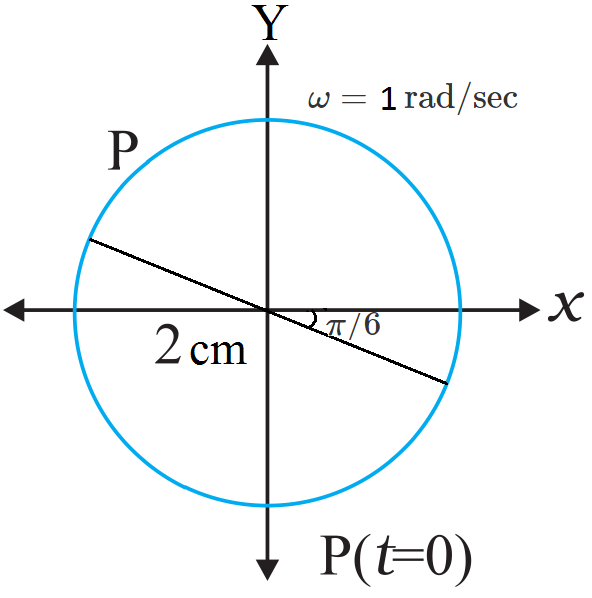
Plot the corresponding reference circle for each of the following simple harmonic motions. Indicate the initial (t = 0) position of the particle, the radius of the circle, and the angular speed of the rotating particle. For simplicity, the sense of rotation may be fixed to be anticlockwise in every case: (x is in cm and t is in s).$\text{x}=\cos\Big(\frac{\pi}{6}-\text{t}\Big)$
Answer

$\text{x}=\cos\Big(\frac{\pi}{6}-\text{t}\Big)=\cos\Big(\text{t}-\frac{\pi}{6}\Big)$If this equation is compared with the standard SHM equation $\text{x}=\text{A}\cos\bigg(\Big(\frac{2\pi}{\text{T}}\Big)\text{t}+\phi\bigg),$ then we get:
Amplitude, A = 1
Phase angle, $\phi=-\frac{\pi}{6}=-30^\circ$
Angular velocity, $\omega=\frac{2\pi}{\text{T}}=1\text{rad/s}$
The motion of the particle can be plotted as shown in the following figure.

Need a full question paper?

Generate a complete, print-ready paper with questions like this in minutes — across 16+ boards, with answer keys.

Start Generating Free

Similar questions

Suppose the platform with the kid in the previous problem is rotating in anticlockwise direction at an angular speed $\omega.$ The kid starts walking along the rim with a speed v relative to the platform also in the anticlockwise direction. Find the new angular speed of the platform.
From parallax measurement, the sun is found to be at a distance of about 400 times the earth-moon distance. Estimate the ratio of sun-earth diameters.
Find the value of $60W$ on a system having $100g, 20cm$ and $1$ minute as the fundamental units.
Which of the following length measurement is most accurate and why?
  1. $4.00\ cm$
  2. $0.004\ mm$
  3. $40.00\ cm$
ls it always true that for two sources of equal intensity, the number of photons emitted in a given time are equal?
The displacement of a progressive wave is represented by $\text{y} = \text{A} \sin(\omega \text{t} – \text{k x} ),$ where $x$ is distance and $t$ is time. Write the dimensional formula of $(i) \omega$ and $(ii) k.$
In an ideal spring the law $\vec{F}=-k \vec{x}$ is followed. Here $k$ is the spring constant. Calculate the work done by the spring in stretching it to a distance $x$ from its equilibrium position by integral method and graphical method
 A person in an elevator accelerating upwards with an acceleration of $2 m s ^{-2}$, tosses a coin vertically upwards with a speed of 20 m $s ^1$. After how much time will the coin fall back into his hand? $\left( g =10 m s ^{-2}\right)$
A bullet of mass $10g$ and speed $500m/s$ is fired into a door and gets embedded exactly at the centre of the door. The door is $1.0m$ wide and weighs $12kg$. It is hinged at one end and rotates about a vertical axis practically without friction. Find the angular speed of the door just after the bullet embeds into it. (Hint: The moment of inertia of the door about the vertical axis at one end is $ML^2/3$).
A man of mass $70kg$ stands on a weighing scale in a lift which is:
  1. Moving upwards with a uniform speed of $10m/ s$.
  2. Moving down with a uniform acceleration of $5m/ s^2$.
  3. Freely falling under gravity.
What would be reading on the scale in each case?