Question
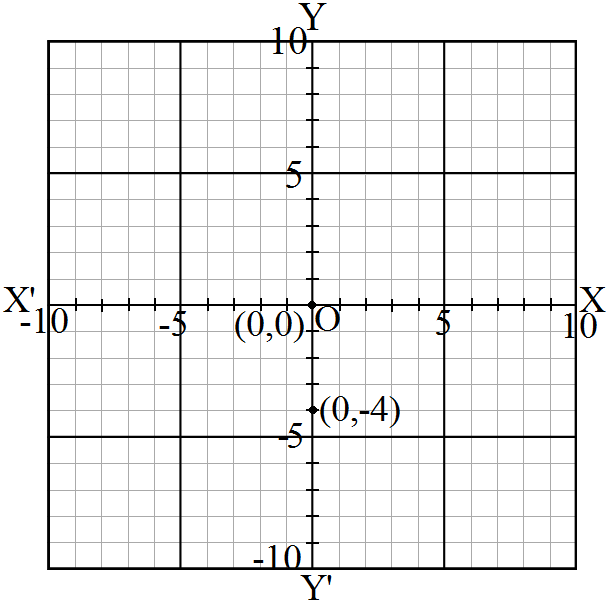
Plot the following points on the graph paper:(0, -4)
Answer

The given points are,
A(2, 5), B(4, -3), C(-5, -7), D(7, -4), E(-3, 2), F(7, 0), G(-4, 0), H(0, -4), J(0, 0),
Let X'OX and Y'OY be the coordinate axes.
Here for the given point the abscissa is 0 units and ordinate is -4 units. The point is on the y-axis. So it will look like as shown in the following figure.

Need a full question paper?

Generate a complete, print-ready paper with questions like this in minutes — across 16+ boards, with answer keys.
Start Generating Free

Similar questions

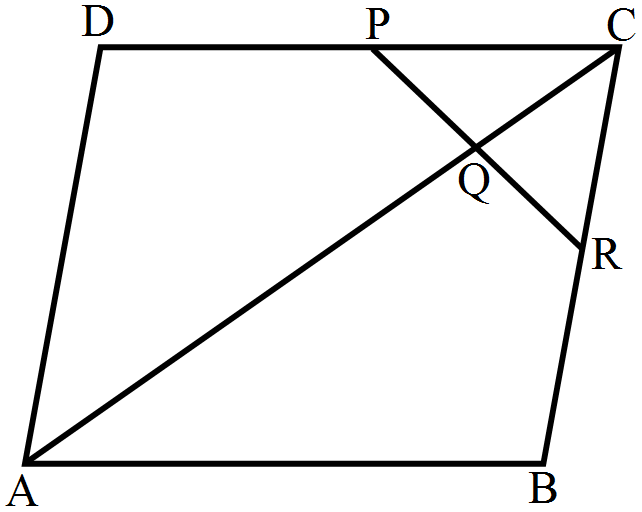
In ABCD is a parallelogram in which P is the mid-points of DC and Q is a point on AC such that $\text{CQ}=\frac{1}{4}\text{AC}.$ if PQ produced meets BC at E, prove R is a mid-points of BC.
Draw a line segment AB and by ruler and compasses, obtain a line segment of length $\frac{3}{4}\text{(AB)}.$
The ratio between the radius of the base and height of a cylinder is $2 : 3.$ If its volume is $1617\ cm^3,$ find the total surface area of the cylinder.
The following table shows the interest paid by a company (in lakhs):
Year
1995–96
1996–97
1997–98
1998–99
1999–2000
Interest (in lakhs of rupees)
20
25
15
18
30
Draw the bar graph to represent the above information.
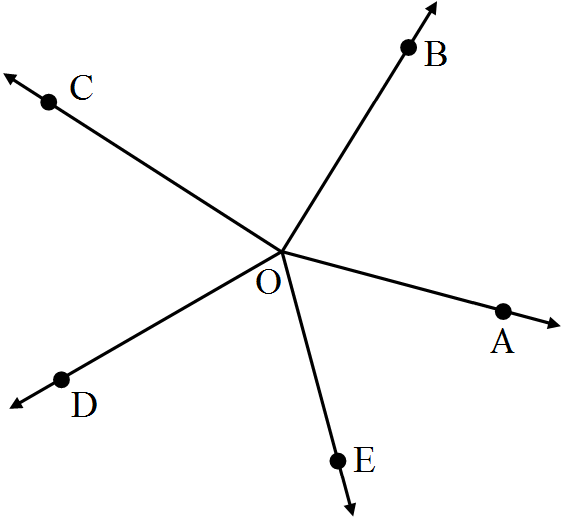
In figure, rays OA, OB, OC, OD and OE have the common end point O. Show that $\angle\text{AOB}+\angle\text{BOC}+\angle\text{COD}+\angle\text{DOE}+\angle\text{EOA}=360^\circ.$
Find the area of the quadrilateral $\text{ABCD}$ in which $AB = 3\ cm, BC = 4\ cm, CD = 4\ cm, DA = 5\ cm$ and $AC = 5\ cm.$
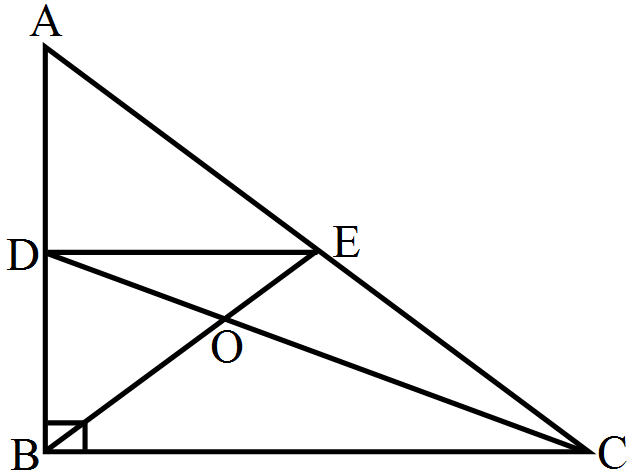
In figure, Triangle $\text{ABC}$ is a right angled triangle at $B.$ Given that $AB = 9\ cm, AC = 15\ cm$ and $D, E$ are the mid$-$points of the sides $AB$ and $AC$ respectively, calculate
$i.$The length of $BC$
$ii.$The area of $\triangle\text{ADE}.$
A rhombus sheet, whose perimeter is $32m$ and whose diagonal is $10m$ long, is painted on both the sides at the rate of $₹ 5$ per meter square. Find the cost of painting.
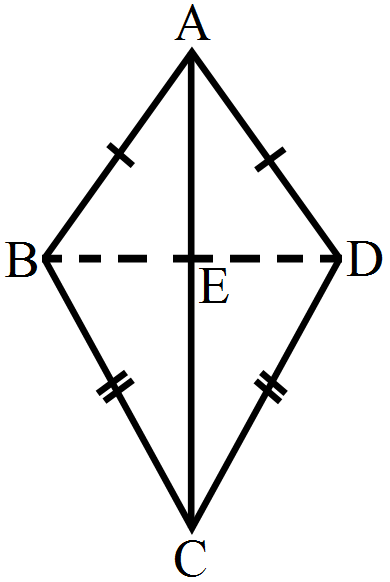
In the given figure, ABCD is a quadrilateral in which AB = AD and BC = DC. Prove that
  1. AC bisects $\angle\text{A}$ and $\angle\text{C},$
  2. BE = DE,
  3. $\angle\text{ABC}=\angle\text{ADC}.$
In a $\triangle\text{ABC},$ P and Q are respectively the mid points of AB and BC and R is the midpoint of AP. Prove that:
  1. $\text{ar}(\triangle\text{PBQ})=\text{ar}(\triangle\text{ARC}).$
  2. $\text{ar}(\triangle\text{PRQ})=\frac{1}{2}\text{ar}(\triangle\text{ARC}).$
  3. $\text{ar}(\triangle\text{EQC})=\frac{3}{8}\text{ar}(\triangle\text{ABC}).$