Question
Plot the points A(1, -1) and B(4, 5):
  1. Draw a line segment joining these points. Write the coordinates of a point on this line segment between the points A and B.
  2. Extend this line segment and write the coordinates of a point on this line which lies outside the line segment AB.
Answer

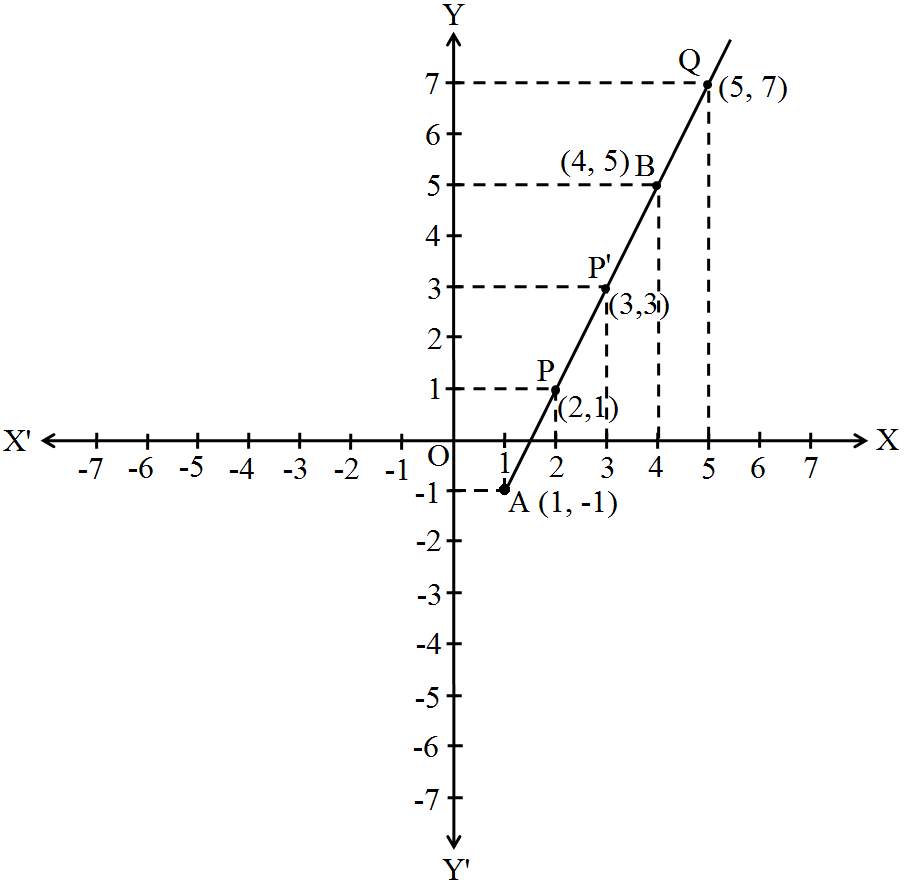
In point A(1, -1), x-coordinate is positive and y-coordinate is negative, so it lies in IV quadrant. In point B(4, 5), both coordinates are positive, so it lies in I quadrant. On plotting these point, we get the following graph.

  1. On joining the points A and B, we get the line segment AB. Now, to find the coordinates of a point on this line segment between A and B draw a perpendicular to X-axis from x = 2 and 3. [since, x = 2 and 3 lies between A and B] say it intersect line segment AB at P and p’. Now, draw a perpendicular to Y-axis from P and p’, they intersect Y axis at y = 1 and 3, respectively. Thus, we get points (2,1) and (3, 3) which lie between line segment AB.
  2. Extent the line segment AB. Now, draw a perpendicular to X-axis from x = 5, say it intersects extended line segment at Q. Again, draw a perpendicular to Y-axis from Q and it intersects Y-axis at y = 7. Thus, we get the point Q(5,7) which lies outside the line segment AB.
Need a full question paper?

Generate a complete, print-ready paper with questions like this in minutes — across 16+ boards, with answer keys.

Start Generating Free

Similar questions

The midpoints of the sides AB, BC, CD and DA of a quadrilateral ABCD are joined to form a quadrilateral. If AC = BD and $\text{AC}\perp\text{BD}$ then prove that the quadrilateral formed is a square.
In the given figure, O is the centre of the circle, BD = OD and $\text{CD}\perp\text{AB}.$ Find $\angle\text{CAB}.$

Calculate the area of the triangle whose sides are 18cm, 34cm, 24cm and 30cm in length. Also, find the length of the altitude corresponding to the smallest side. 
In a parallelogram PQRS, PQ = 12cm and PS = 9cm. The bisector of $\angle\text{P}$ meets SR in M. PM and QR both when produced meet at T. Find the length of RT.
If $\text{x}+\frac{1}{\text{x}}=3,$ calculate $\text{x}^2+\frac{1}{\text{x}^2},\ \text{x}^3+\frac{1}{\text{x}^3}$ and $\text{x}^4+\frac{1}{\text{x}^4}.$
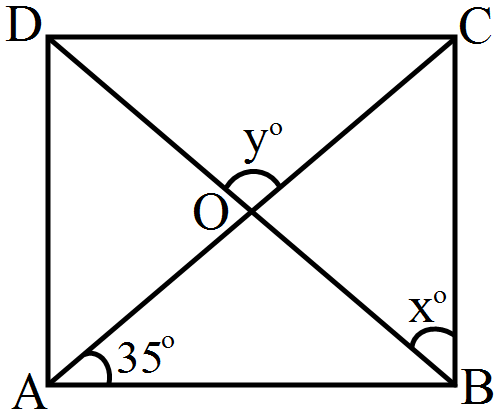
In each of the figures given below, ABD is a rectangle. Find the values of x and y in each case.

In the adjoining figure, ABCD is a parallelogram in which $\angle\text{BAO}=35^{\circ},\angle\text{DAO}=40^{\circ}$ and $\angle\text{COD}=150^{\circ}.$ Calculate
  1. $\angle\text{ABO},$
  2. $\angle\text{ODC},$
  3. $\angle\text{ACB},$
  4. $\angle\text{CBD}.$

A cylinder and a cone have equal radii of their bases and equal heights. If their curved surface areas are in the ratio 8 : 5, show that the radius and height of each has the ratio 3 : 4.
Draw a histogram for the follwoing data:
Class intervals
600-640
640-680
680-720
720-760
760-800
800-840
Frequency
18
45
153
288
171
63
Using this histrogram, draw the frequency polygon on the same graph.
In the given figure, AB || CD. Find the value of x.