MCQ
Point from which two distinct tangents can be drawn on two different branches of the hyperbola $\frac{{{x^2}}}{{25}} - \frac{{{y^2}}}{{16}} = \,1$ but no two different tangent can be drawn to the circle $x^2 + y^2 = 36$ is
  • A
    $(1,6)$
  • $(1,3)$
  • C
    $(7,1)$
  • D
    $(1,\frac{1}{2})$

Answer

Correct option: B.
$(1,3)$
b
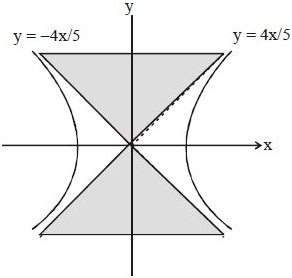
Region where $2$ tangents to two different branches can be drawn.

$\therefore(1,6),(1,3)$

But from $(1,6) 2$ tangents to circle can be drawn

$\therefore$ Ans. $(1,3)$

Need a full question paper?

Generate a complete, print-ready paper with questions like this in minutes — across 16+ boards, with answer keys.

Start Generating Free

Similar questions

Suppose the parabola $(y-h)^2=4(x-h)$, with vertex $A$, passes through $O=(0,0)$ and $L=(0,2)$. Let $D$ be an end point of the latusrectum. Let the $Y$-axis intersect the axis of the parabola at $P$. Then, $\angle P D A$ is equal to
The equation of a line passing through the centre of a rectangular hyperbola is $x -y -1 = 0$. If one of the asymptotes is $3x -4y -6 = 0$, the equation of other asymptote is
Suppose a parabola $y=a x^2+b x+c$ has two $x$ intercepts, one positive and one negative, and its vertex is $(2,-2)$. Then, which of the following is true?
If $p,\;q,\;r$ are in one geometric progression and $a,\;b,\;c$ in another geometric progression, then $cp,\;bq,\;ar$ are in
If two mutually perpendicular lines through the point $A(1, 1)$ intersect $x$ & $y$ axis at points $B$ & $C$ respectively, then locus of centroid of $\Delta ABC$ is -
If $n(U)$ = $600$ , $n(A)$ = $100$ , $n(B)$ = $200$ and $n(A \cap  B )$ = $50$, then $n(\bar A  \cap \bar B )$ is 

($U$ is universal set and $A$ and $B$ are subsets of $U$)

$\int_1^e {\frac{1}{x}\,dx} $ is equals to
Area of the quadrilateral formed with the foci of the hyperbola $\frac{{{x^2}}}{{{a^2}}} - \frac{{{y^2}}}{{{b^2}}} = 1$ and $\frac{{{x^2}}}{{{a^2}}} - \frac{{{y^2}}}{{{b^2}}} =  - 1$ is
Let Ajay will not appear in JEE exam with probability $\mathrm{p}=\frac{2}{7}$, while both Ajay and Vijay will appear in the exam with probability $\mathrm{q}=\frac{1}{5}$. Then the probability, that Ajay will appear in the exam and Vijay will not appear is :
For the system of linear equations

$2 x-y+3 z=5$

$3 x+2 y-z=7$

$4 x+5 y+\alpha z=\beta$

Which of the following is NOT correct ?