MCQ
Positive rays was discovered by
  • Thomson
  • B
    Goldstein
  • C
    W. Crookes
  • D
    Rutherford

Answer

Correct option: A.
Thomson
a
(a)Positive rays was discovered by J.J. Thomson.

Need a full question paper?

Generate a complete, print-ready paper with questions like this in minutes — across 16+ boards, with answer keys.
Start Generating Free

Similar questions

Which of the following is constructed on the principle of electromagnetic induction
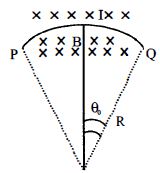
A wire carrying current $I$ is tied between points $P$ and $Q$ and is in the shape of a circular arc of radius $R$ due to a uniform magnetic field $B$ (perpendicular to the plane of the paper, shown by $\times \times \times $) in the vicinity of the wire. If the wire subtends an angle $2\theta_0$ at the centre of the circle (of which it forms an arc) then the tension in the wire is
A ring of radius R, made of an insulating material carries a charge Q uniformly distributed on it. If the ring rotates about the axis passing through its centre and normal to plane of the ring with constant angular speed ω, then the magnitude of the magnetic moment of the ring is
The half-life period of a radio-active element $X$ is same as the mean life time of another radio-active element $Y$ Initially they have the same number of atoms. Then
One face of a rectangular glass plate $6 \,cm$ thick is silvered. An object held $8\, cm$ in front of the first face, forms an image $12\, cm$ behind the silvered face. The refractive index of the glass is
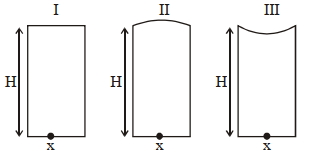
Three glass cylinders of equal height $H =30 cm$ and same refractive index $n =1.5$ are placed on a horizontal surfaces shown in figure. Cylinder I has a flat top, cylinder II has a convex top and cylinder III has a concave top. The radii of curvature of the two curved tops are same $( R =3 m )$, If $H _1, H _2$ and $H _3$ are the apparent depths of a point $X$ on the bottom of the three cylinders, respectively, the correct statement($s$) is/are

$(1)$ $H _3> H _1$ $(2)$ $0.8 cm <\left( H _2- H _1\right)<0.9 cm$ $(3)$ $H _2> H _3$  $(4)$ $H _2> H _1$
An electron changes its position from orbit $n = 4$ to the orbit $n = 2$ of an atom. The wavelength of the emitted radiation’s is ($R =$ Rydberg’s constant)
Half-lives of two radioactive elements $A$ and $B$ are $20$ minutes and $40$ minutes, respectively. Initially, the samples have equal number of nuclei. After $80$ minutes, the ratio of decayed number of $A$ and $B$ nuclei will be
The intensity of an electric field with E= 0 will change with distance:
An orbital electron in the ground state of hydrogen has magnetic moment $\mu_1$.  This orbital electron is excited to $3^{rd}$ excited state by some energy transfer to the hydrogen atom. The new magnetic moment of the electron is $\mu_2$ , then