MCQ
Possible number of orientations of a subshell is
  • A
    $l$
  • B
    $n$
  • $2l + 1$
  • D
    $n^2$

Answer

Correct option: C.
$2l + 1$
c

Need a full question paper?

Generate a complete, print-ready paper with questions like this in minutes — across 16+ boards, with answer keys.

Start Generating Free

Similar questions

What is the equivalent mass of $IO_4^ - $ when it is converted into ${I_2}$ in acid medium
Choose the correct order of atomic radii of fluorine and neon (in pm) out of the options given below and justify your answer.
For electrons having principal quantum number are $3,$ the number of $(i)$ subshells and $(ii)$ orbitals would be respectively
Which one of the following is most soluble
The most stable resonating structure of $CH_3 -O -CH = CH_2$ is
The correct order of electron affinity of $B, C, N, O$ is
The heat change for the following reaction $C(s) + 2S(s) \to C{S_2}(l)$ is known as
Assertion : $SiF_6^{2-}$ is known but $SiCl_6^{2-}$ is not

Reason : Size of fluorine is small and its lone pair of electrons interacts with $d-$ orbitals of $Si$ strongly.

The $IUPAC$ name of  $\begin{array}{*{20}{c}}
  {\,\,\,\,\,\,\,\,\,\,\,\,\,\,\,\,\,\,\,\,\,\,\,\,\,\,\,\,\,\,\,\,\,\,\,\,\,\,\,\,\,\,\,\,\,\,\,\,\,\,\,\,\,\,\,\,\,\,\,\,\,\,\,\,\,\,O} \\ 
  {\,\,\,\,\,\,\,\,\,\,\,\,\,\,\,\,\,\,\,\,\,\,\,\,\,\,\,\,\,\,\,\,\,\,\,\,\,\,\,\,\,\,\,\,\,\,\,\,\,\,\,\,\,\,\,\,\,\,\,\,\,\,\,\,\,\,\,\,||} \\ 
  {C{H_3} - C = CH - C{H_2} - C} \\ 
  {\,\,\,\,\,\,\,\,\,\,\,\,\,\,\,\,\,\,\,\,|\,\,\,\,\,\,\,\,\,\,\,\,\,\,\,\,\,\,\,\,\,\,\,\,\,\,\,\,\,\,\,\,\,\,\,\,\,\,\,\,\,\,\,\,\,\,\,|} \\ 
  {\,\,\,\,\,\,\,\,\,\,\,\,\,\,\,\,\,\,\,\,\,\,\,\,\,\,COO{C_2}{H_5}\,\,\,\,\,\,\,\,\,\,\,\,\,\,\,\,\,\,\,\,\,\,\,\,OH\,} 
\end{array}$ is
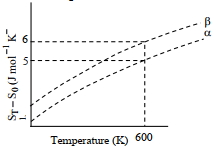
The entropy versus temperature plot for phases $\alpha$ and $\beta$ at 1 bar pressure is given. $S_{\mathrm{T}}$ and $S_0$ are entropies of the phases at temperatures $\mathrm{T}$ and $0 \mathrm{~K}$, respectively.

(image)

The transition temperature for $\alpha$ to $\beta$ phase change is $600 \mathrm{~K}$ and $C_{p, \beta}-C_{p, \alpha}=1 \mathrm{~J} \mathrm{~mol}^{-1} \mathrm{~K}^{-1}$. Assume $\left(C_{p, \beta}-C_{p, \alpha}\right)$ is independent of temperature in the range of 200 to $700 \mathrm{~K} . \mathrm{C}_{p, \alpha}$ and $C_{p, \beta}$ are heat capacities of $\alpha$ and $\beta$ phases, respectively.

($1$)The value of entropy change, $\mathrm{S}_\beta-\mathrm{S}_\alpha$ (in $\mathrm{J} \mathrm{mol}^{-1} \mathrm{~K}^{-1}$ ), at $300 \mathrm{~K}$ is. . . . . . .

[Use : $\ln 2=0.69$  Given : $S_\beta-S_\alpha=0$ at $\left.0 \mathrm{~K}\right]$

($2$) The value of enthalpy change, $\mathrm{H}_\beta-\mathrm{H}_\alpha$ (in $J$ mol ${ }^{-1}$ ), at $300 \mathrm{~K}$ is

Give the answer quetion ($1$) and ($2$)