MCQ
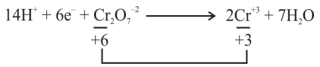
Potassium dichromate acts as a strong oxidizing agent in acidic solution. During this process, the oxidation state changes from
  • A
    $+3$ to $+1$
  • $+6$ to $+3$
  • C
    $+2$ to $+1$
  • D
    $+6$ to $+2$

Answer

Correct option: B.
$+6$ to $+3$
b

Need a full question paper?

Generate a complete, print-ready paper with questions like this in minutes — across 16+ boards, with answer keys.
Start Generating Free

Similar questions

Calculate solubility (in moles/litre) of a saturated aqueous solution of $Ag_3PO_4$ if the vapour pressure of the solution becomes $750\ torr$ at $373\ K$
The oxidation number of $Mn$ in $KMn{O_4}$ is 
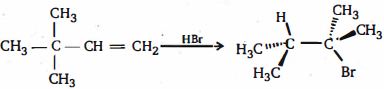
Consider the addition of $HBr$ to $3,3$ -Dimethyl- $1$ -butene shown below. What is  the best mechanistic explanation for the formation of the observed product ?
The $\Delta S$ for the vaporisation of $1$ $mol$ of water is $88.3 $ $J/mole\, K$ . The value of $\Delta S$ for the condensation of $1 $ $mol$ of vapour will be.......$ J/mol\, K$
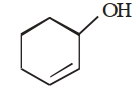
According to $IUPAC$ system, the compound $image$ is named as
For the following gaseous reaction ${H_2} + {I_2}$ $\rightleftharpoons$ $2HI$, the equilibrium constant
An aqueous solution ox $X$ is added slowly to an aqueous solution of $Y$ as shown in list $I$. The variation in conductivity of these reactions is given in List $II$. Match List $I$ with List $II$ and select the correct answer using the code given below the lists :

List $I$ List $II$
$P$. $\quad \underset{X}{\left( C _2 H _5\right)_3 N }+\underset{ Y }{ CH _3 COOH }$ $1.$ Conductivity decreases and then increases
$Q.$ $\quad \underset{X}{ KI (0.1 M )}+\underset{ Y }{ AgNO _3(0.01 M )}$ $2.$ Conductivity decreases and then does not change much
$R.$ $\quad \underset{X}{ CH _3 COOH }+\underset{ K }{ KOH }$ $3.$ Conductivity increases and then does not change much
$S$. $\quad \underset{X}{ NaOH }+\underset{Y}{ HI }$ $4.$ Conductivity does not change much and then increases

Codes: $ \quad P \quad Q \quad R \quad S $ 
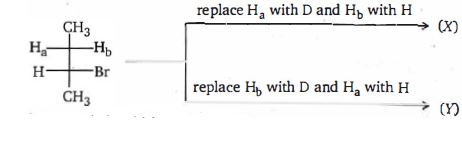
Relation between $(X)$ and $(Y)$ is 
The number of geometric isomers that can exist for square planar complex $[Pt\, (Cl)\, (py)\, (N H_3) \,(NH_2O H)]^+$ is ($py=$pyridine) :
Urea