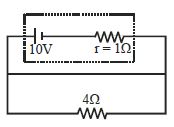
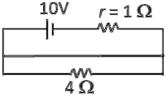
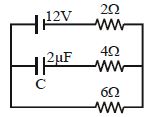
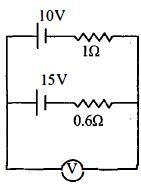
Potential difference across the terminals of the battery shown in figure is .................... $V$ ($r =$ internal resistance of battery)
Medium


Download our appand get started for free
Experience the future of education. Simply download our apps or reach out to us for more information. Let's shape the future of learning together!No signup needed.*
Similar Questions
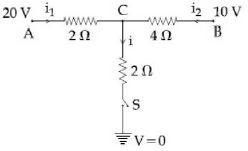
- 1When the switch $S$, in the circuit shown, is closed, then the value of current $i$ will be ................. $A$View Solution
- 2$50\,\Omega $ and $100\,\Omega $ resistors are connected in series. This connection is connected with a battery of $2.4\, volts$. When a voltmeter of $100\,\Omega $ resistance is connected across $100\,\Omega $ resistor, then the reading of the voltmeter will be ............. $V$View Solution
- 3Charge on the capacitor in the given circuit in steady state condition is :- ............... $\mu C$View Solution
- 4A current of $2\, mA$ was passed through an unknown resistor which dissipated a power of $4.4\, W$. Dissipated power when an ideal power supply of $11\, V$ is connected across it isView Solution
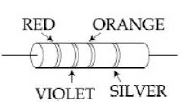
- 5View SolutionA resistance is shown in the figure. Its value and tolerance are given respectively by
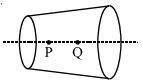
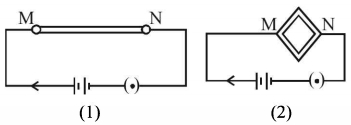
- 6A wire is connected to a battery between the point $M$ and $N$ as shown in the figure $(1)$. The same wire is bent in the form of a square and then connected to the battery between the points $M$ and $N$ as shown in the figure $(2)$. Which of the following quantities increases?View Solution
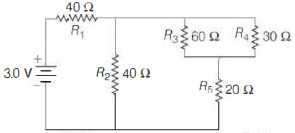
- 7In the circuit shown below, the resistances are given (in $\Omega$ ) and the battery is assumed ideal with emf equal to $3.0 \,V$. The resistor that dissipates the most power isView Solution
- 8In an electrolyte $3.2 \times {10^{18}}$ bivalent positive ions drift to the right per second while $3.6 \times {10^{18}}$ monovalent negative ions drift to the left per second. Then the current isView Solution
- 9A $10\,V$ battery with internal resistance $1\,\Omega $ and a $15\,V$ battery with internal resistance $0.6\,\Omega $ are connected in parallel to a voltmeter (see figure). The reading in the voltmeter will be close to ................ $V$View Solution
- 10A wire has a non-uniform cross-section as shown in figure.A steady current flows through it. The drift speed of electrons at points $P$ and $q$ is $v_P$ and $v_Q$.View Solution