Question
Need a full question paper?
Generate a complete, print-ready paper with questions like this in minutes — across 16+ boards, with answer keys.
Explore more
Similar questions
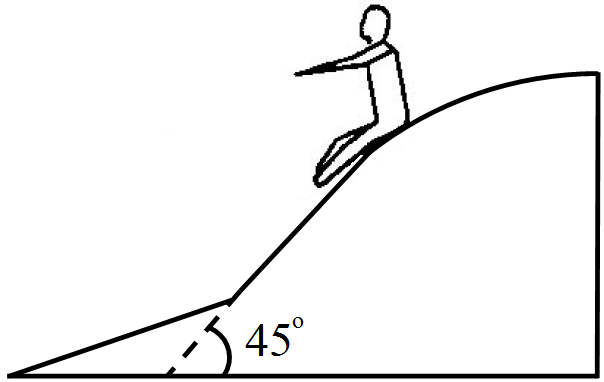
In a children-park an inclined plane is constructed with an angle of incline $45°$ in the middle part. Find the acceleration of a boy sliding on it if the friction coefficient between the cloth of the boy and the incline is $0.6$ and $g = 10m/s^2$.
→To keep valuable instruments away from the earth's magnetic field, they are enclosed in iron boxes. Explain.
Read the passage given below and answer the following questions from (i) to (v). Monatomic Gases: The molecule of a monatomic gas has only three translational degrees of freedom. Thus, the average energy of a molecule at temperature T is $\frac{3}{2}\text{K}_\text{b}\text{T}$. The total internal energy of a mole of such a gas is $\text{U}=(\frac{3}{2})\text{RT}$. The molar specific heat at constant volume cv is given by$\text{C}_{\text{v}}=\frac{\text{Du}}{\text{Dt}}=(\frac{3}{2})\text{R}$
For an ideal gas, $C_p - C_v = R$ Where Cp is the molar specific heat at constant pressure. Thus, $\text{C}_\text{P} =(\frac{5}{2})\text{R}$ The ratio of specific heats IS $\gamma=\frac{\text{cp}}{\text{cv}}=\frac{5}{3}$ Diatomic Gases: a diatomic molecule treated as a rigid rotator, like a dumbbell, has 5 degrees of freedom: 3 translational and 2 rotational. Using the law of equipartition of energy, the total internal energy of a mole of such a gas is $\text{U}=\frac{5}{2}\text{RT}$ The molar specific heat at constant volume cv is given by$\text{Cv}=\frac{\text{DU}}{\text{DT}}=(\frac{5}{2})\text{R}$
For an ideal gas, $C_p – C_v= R$ Where Cp is the molar specific heat at constant pressure. Thus, $\text{C}_\text{P} =(\frac{7}{2})\text{R}$ The ratio of specific heats IS $γ( \text{for rigid diatomic)}=\frac{\text{C}_\text{P}}{\text{C}_\text{v}} =(\frac{7}{5})\text{R}$ For non rigid diatomic molecules they have additional mode of vibrations therefore$\gamma=\frac{\text{C}_\text{p}}{\text{C}_\text{v}}=\frac{9}{7}$
Polyatomic Gases: In general a polyatomic molecule has 3 translational, 3 rotational degrees of freedom and a certain number (f) of vibrational modes. According to the law of equipartition of energy, it is easily seen that one mole of such a gas has$ C_v= (3 + f)$ R and $C_p= (4 + f) R$ and $\gamma=\frac{(4 + \text{f})}{(3+\text{f})}$
→For an ideal gas, $C_p - C_v = R$ Where Cp is the molar specific heat at constant pressure. Thus, $\text{C}_\text{P} =(\frac{5}{2})\text{R}$ The ratio of specific heats IS $\gamma=\frac{\text{cp}}{\text{cv}}=\frac{5}{3}$ Diatomic Gases: a diatomic molecule treated as a rigid rotator, like a dumbbell, has 5 degrees of freedom: 3 translational and 2 rotational. Using the law of equipartition of energy, the total internal energy of a mole of such a gas is $\text{U}=\frac{5}{2}\text{RT}$ The molar specific heat at constant volume cv is given by$\text{Cv}=\frac{\text{DU}}{\text{DT}}=(\frac{5}{2})\text{R}$
For an ideal gas, $C_p – C_v= R$ Where Cp is the molar specific heat at constant pressure. Thus, $\text{C}_\text{P} =(\frac{7}{2})\text{R}$ The ratio of specific heats IS $γ( \text{for rigid diatomic)}=\frac{\text{C}_\text{P}}{\text{C}_\text{v}} =(\frac{7}{5})\text{R}$ For non rigid diatomic molecules they have additional mode of vibrations therefore$\gamma=\frac{\text{C}_\text{p}}{\text{C}_\text{v}}=\frac{9}{7}$
Polyatomic Gases: In general a polyatomic molecule has 3 translational, 3 rotational degrees of freedom and a certain number (f) of vibrational modes. According to the law of equipartition of energy, it is easily seen that one mole of such a gas has$ C_v= (3 + f)$ R and $C_p= (4 + f) R$ and $\gamma=\frac{(4 + \text{f})}{(3+\text{f})}$
- For monatomic molecules ratio of specific heats is $\gamma$
- $\frac{5}{3}$
- $\frac{7}{5}$
- $\frac{9}{5}$
- None of these
- For diatomic rigid molecules ratio of specific heats is γ
- $\frac{5}{3}$
- $\frac{7}{5}$
- $\frac{9}{7}$
- None of these
- For diatomic non rigid molecules ratio of specific heats is γ
- $\frac{5}{3}$
- $\frac{7}{5}$
- $\frac{9}{7}$
- None of these
- Give cp and cv values and ratio of specific heat for monatomic gas molecules.
- Give cp and cv values and ratio of specific heat for polyatomic gas molecules
Mr. Verma $(50kg)$ and Mr. Mathur $(60kg)$ are sitting at the two extremes of a $4m$ long boat $(40kg)$ standing still in water. To discuss a mechanics problem, they come to the middle of the boat. Neglecting friction with water, how far does the boat move on the water during the process?
→Read the passage given below and answer the following questions from i to v. If an object moving along the straight line covers equal distances in equal intervals of time, it is said to be in uniform motion along a straight line. Distance and displacement are two quantities that seem to mean the same but are different with different meanings and definitions. Distance is the measure of actual path length travelled by object. It is scalar quantity having SI unit of metre while displacement refers to the shortest distance between initial and final position of object. It is vector quantity. The magnitude of the displacement for a course of motion may be zero but the corresponding path length is not zero. using this data answer following questions.
- Can path length be zero for motion of body from one point to other point?
- Yes
- No
- For any given motion from point A to B, displacement =10m and distance = 5m. Is it possible?
- Yes
- No
- For rectilinear motion displacement can be
- Positive only
- Negative only
- Can be zero
- All of the above
- Define distance and displacement of particle.
- Write difference between distance and displacement.
Calculate the amplification factor of a triode valve that has plate resistance of $2\text{k}\Omega$ and transconductance of 2 millimho.
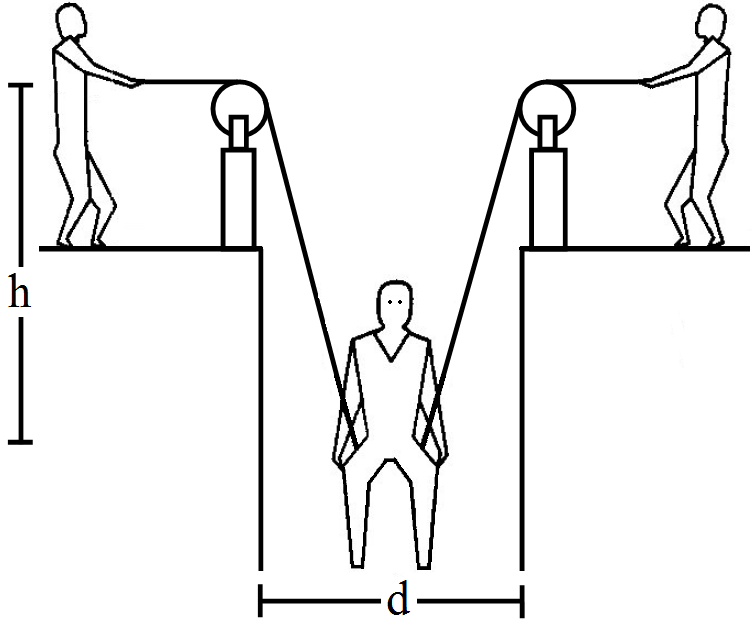
→A man has fallen into a ditch of width d and two of his friends are slowly pulling him out using a light rope and two fixed pulleys as shown in figure. Show that the force (assumed equal for both the friends) exerted by each friend on the road increases as the man moves up. Find the force when the man is at a depth h.
Read the passage given below and answer the following questions from 1 to 5. Simple Harmonic Motion Simple harmonic motion is the simplest form of oscillation. A particular type of periodic motion in which a particle moves to and fro repeatedly about a mean position under the influence of a restoring force is termed as simple harmonic motion (S.H.M). A body is undergoing simple harmonic motion if it has an acceleration which is directed towards a fixed point, and proportional to the displacement of the body from that point. Acceleration $\text{a}\propto-\text{x}$$\Rightarrow\text{a}=-\text{kx}$ or $\frac{\text{d}^2\text{x}}{\text{dt}^2}=-\text{kx},$
where x = displacement at any instant t.
→→where x = displacement at any instant t.
- Which of the following is not a characteristics of simple harmonic motion?
- The motion is periodic.
- The motion is along a straight line about the mean position.
- The oscillations are responsible for the energy conversion.
- The acceleration of the particle is directed towards the extreme position.
- The equation of motion of a simple harmonic motion is:
- $\frac{\text{d}^2\text{x}}{\text{dt}^2}=-\omega^2\text{x}$
- $\frac{\text{d}^2\text{x}}{\text{dt}^2}=-\omega^2\text{t}$
- $\frac{\text{d}^2\text{x}}{\text{dt}^2}=-\omega\text{x}$
- $\frac{\text{d}^2\text{x}}{\text{dt}^2}=-\omega\text{t}$
- Which of the following expressions does not represent simple harmonic motion?
- $\text{x}=\text{A}\cos\omega\text{t}+\text{B}\sin\omega\text{t}$
- $\text{x}=\text{A}\cos(\omega\text{t}+\alpha)$
- $\text{x}=\text{B}\sin(\omega\text{t}+\beta)$
- $\text{x}=\text{A}\sin\omega\text{t}\cos^2\omega\text{t}$
- The time period of simple harmonic motion depends upon:
- Amplitude
- Energy
- Phase constant
- Mass
- Which of the following motions is not simple harmonic?
- Vertical oscillations of a spring
- Motion of a simple pendulum
- Motion of planet around the Sun
- Oscillation of liquid in a U-tube
Two speakers $S_1$ and $S_2$, driven by the same amplifier, are placed at $y = 1.0m$ and $y = -1.0m$ figure, The speakers vibrate in phase at $600Hz$. A man stands at a point on the X-axis at a very large distance from the origin and starts moving parallel to the Y-axis. The speed of sound in air is $330m/s$.
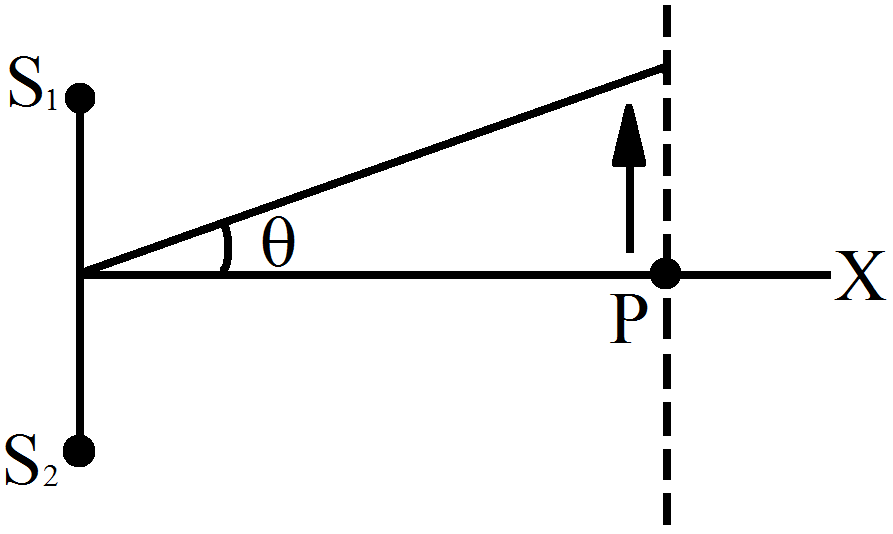
→- At what angle $\theta$ will the intensity of sound drop to a minimum for the first time?
- At what angle will he hear a maximum of sound intensity for the first time?
- If he continues to walk along the line, how many more maxima can he hear?