MCQ
Potentiometer measures potential more accurately because:
- AIt measures potential in open circuit.
- BIt uses sensitive galvanometer for null deflection.
- CIt uses high resistance potentiometer wire.
- DIt measures potential in closed circuit.
Generate a complete, print-ready paper with questions like this in minutes — across 16+ boards, with answer keys.
A long wire A carries a current of 10 amp. Another long wire B, Which is parallel to A and separated by 0.1m from A, carries a current of 5 amp, in the opposite direction to that in A. what is the magnitude and nature of the force experienced per unit length of B (
|
(a) Repulsive force of |
(b) Attractive force of |
|
(c) Repulsive force of 2π × |
(d) Attractive force of 2π |
The ratio of the wavelengths for 2 → 1 transition in Li++, He+ and H is
|
(a) 1 : 2 : 3 |
(b) 1 : 4 : 9 |
(c) 4 : 9 : 36 |
(d) 3 : 2 : 1 |
The photoelectric threshold wavelength for a metal surface is 6600 Å. The work function for this is
|
(a) 1.87 V |
(b) 1.87 eV |
(c) 18.7 eV |
(d) 0.18 eV |
Assuming photoemission to take place, the factor by which the maximum velocity of the emitted photoelectrons changes when the wavelength of the incident radiation is increased four times, is
|
(a) 4 |
(b) |
(c) 2 |
(d) |
Assertion : Gauss theorem is not applicable in magnetism.
Reason : Mono magnetic pole does not exist.
|
(a) If both assertion and reason are true and the reason is the correct explanation of the assertion. |
|
(b) If both assertion and reason are true but reason is not the correct explanation of the assertion. |
|
(c) If assertion is true but reason is false. |
|
(d) If the assertion and reason both are false. |
Diffraction effects are easier to notice in the case of sound waves than in the case of light waves because
|
(a) Sound waves are longitudinal |
(b) Sound is perceived by the ear |
|
(c) Sound waves are mechanical waves |
(d) Sound waves are of longer wavelength |
The network shown in the figure is a part of a complete circuit. If at a certain instant the current i is 5 A and is decreasing at the rate of  then
then  is
is
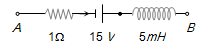
|
(a) 5 V |
(b) 10 V |
(c) 15 V |
(d) 20 V |


