Potentiometer wire of length $1 \,m$ is connected in series with $490\,\Omega $ resistance and $2\,V$ battery. If $0.2\, mV/cm $ is the potential gradient, then resistance of the potentiometer wire is ................ $\Omega$
Medium
Download our app for free and get started
(a) Potential gradient $x = \frac{e}{{(R + {R_h} + r)}}.\frac{R}{L}$
$ \Rightarrow $ $\frac{{0.2 \times {{10}^{ - 3}}}}{{{{10}^{ - 2}}}} = \frac{2}{{(R + 490 + 0)}} \times \frac{R}{1}$ $ \Rightarrow $ $R = 4.9 \,\Omega$.
$ \Rightarrow $ $\frac{{0.2 \times {{10}^{ - 3}}}}{{{{10}^{ - 2}}}} = \frac{2}{{(R + 490 + 0)}} \times \frac{R}{1}$ $ \Rightarrow $ $R = 4.9 \,\Omega$.

Download our appand get started for free
Experience the future of education. Simply download our apps or reach out to us for more information. Let's shape the future of learning together!No signup needed.*
Similar Questions
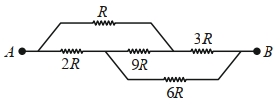
- 1The equivalent resistance between $A$ and $B$ of the network shown in figureView Solution
- 2Two bulbs of $500\, watt$ and $200\, watt$ are manufactured to operate on $220\, volt$ line. The ratio of heat produced in $500\, W$ and $200\, W$, in two cases, when firstly they are joined in parallel and secondly in series, will beView Solution
- 3A student has $10$ resistors of resistance ‘$r$’. The minimum resistance made by him from given resistors isView Solution
- 4The resistance of a wire is $R\; ohm$. If it is melted and stretched to $'n'$ times its original length, its new resistance will beView Solution
- 5In $n_e$ and $v_d$ be the number of electrons and drift velocity in a semiconductor. When the temperature is increasedView Solution
- 6View SolutionWhen current flows through a conductor, then the order of drift velocity of electrons will be
- 7An unknown resistance $R_1$ is connected in series with a resistance of $10 \,\Omega$. This combinations is connected to one gap of a meter bridge while a resistance $R_2$ is connected in the other gap. The balance point is at $50\, cm$. Now, when the $10 \,\Omega$ resistance is removed the balance point shifts to $40\, cm$. The value of $R_1$ is (in $ohm$)View Solution
- 8A battery of internal resistance one ohm and $emf$ $3\,volt$ sends a current through $1\,metre$ of uniform wire of resistance $5\,\Omega $. The pole of the cell of $emf$ $1.4\,volt$ are connected to two points on the wire so that no current passes through this cell. Then, the potential gradient of the wire isView Solution
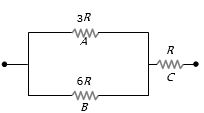
- 9The three resistances $A, B$ and $C$ have values $3R, 6R$ and $R$ respectively. When some potential difference is applied across the network, the thermal powers dissipated by $A, B$ and $C$ are in the ratioView Solution
- 10For driving a current of $2\, A$ for $6$ minutes in a circuit, $1000\, J$ of work is to be done. The $e.m.f.$ of the source in the circuit is ................ $V$View Solution