Question
Predict conditions under which Al might be expected to reduce $MgO.$
$($Hint: See Intext question $6.4)$

Answer

The equations for the formation of the two oxides are
$4/3Al(s) + O_2(s) → 2/3Al_2O_3(s)$
$2Mg(s) + O_2(s) → 2MgO(s)$
If we look at the plots for the formation of the two oxides of the Ellingham diagram, we find that they intersect at certain point. The corresponding value of $\Delta\text{G}^{\circ}$ becomes zero for the reduction of $MgO$ by $Al$ metal.
$2\text{MgO}(\text{s})+4/3\text{Al(s)}\rightleftharpoons2\text{Mg}(\text{s})+2/3\text{Al}_2\text{O}_3(\text{s})$
This means that the reduction of $MgO$ by Al metal can occur below this temperature. Aluminium (Al) metal can reduce $MgO$ to $Mg$ above this temperature because $\Delta^{\circ}\text{G}$ for $Al_20_3$ is less as compared to that of $MgO.$
$3\text{MgO}(\text{s})+2\text{Al}(\text{s})\xrightarrow[]{(>1665\text{k})}\text{Al}_2\text{O}_3(\text{s})+3\text{Mg}(\text{s})$

Need a full question paper?

Generate a complete, print-ready paper with questions like this in minutes — across 16+ boards, with answer keys.
Start Generating Free

Similar questions

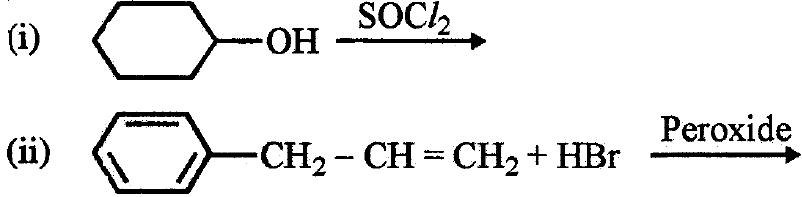
Draw the structure of major monohalo product in each of the following reactions:
How can phenol be converted to aspirin?
Some halogen containing compounds are useful in daily life. Some compounds of this class are responsible for exposure of flora and fauna to more and more of UV light which causes destruction to a great extent. Name the class of these halocompounds. In your opinion, what should be done to minimise harmful effects of these compounds.
Give the general formula of diazonium salt. State the possible negative ions present in this salt and explain with an example how diazonium salts are named.
Differentiate between molality and molarity of a solution. What is the effect of change in temperature of a solution on its molality and molarity?
Account for the following:
  1. Aromatic carboxylic acids do not undergo Friedel-Crafts reaction.
  2. $pK_a$ value of $4-$nitrobenzoic acid is lower than that of benzoic acid.
Following data are obtained for the reaction:
$N_2O_5 \rightarrow 2NO_2 + ½O_2$
$t/s$ $0$ $300$ $600$
$[N2O5]/mol L^{–1}$​​​​​​​ $1.6 \times 10^{–2}$ $0.8 \times 10^{–2}$ $0.4 \times 10^{–2}$
  1. Show that it follows first order reaction.
  2. Calculate the half-life.
$($Given $\log 2 = 0.3010 \log 4 = 0.6021)$
Chlorobenzene is extremely less reactive towards a nucleophilic substitution reaction. Give two reasons for the same.
The partial pressure of ethane over a solution containing $6.56 \times 10^{–3}\ g$ of ethane is 1 bar. If the solution contains $5.00 \times 10^{–2}\ g$ of ethane, then what shall be the partial pressure of the gas?
Account for the following:
$PF_5$ is known but $NF_5$ is not known.