Question
Predict the products formed when cyclohexanecarbaldehyde reacts with following reagents.
$i.\ PhMgBr$ and then $H_3O^+$
$ii.$ Tollens' reagent
$iii.$ Semicarbazide and weak acid
$iv.$ Excess ethanol and acid
$v.$ Zinc amalgam and dilute hydrochloric acid
Answer

Get the step-by-step solution for this question inside the Vidyadip app.

Get the answer in the app

Need a full question paper?

Generate a complete, print-ready paper with questions like this in minutes — across 16+ boards, with answer keys.

Start Generating Free

Similar questions

Give the structures and IUPAC names of the products expected from the following reactions:
a. Catalytic reduction of butanol.
b. Hydration of propene in the presence of dilute sulphuric acid.
c. Reaction of propanone with methyl magnesium bromide followed by hydrolysis.
What is azeotropes? Explain it's Types.
  1. Calculate the mass of Ag deposited at cathode when a current of $2$ amperes was passed through a solution of $AgNO_3$ for $15$ minutes.
$($Given: Molar mass of $Ag = 108 \ g \ mol^{–1} 1F = 96500 \ C \ mol^{–1})$​​​​​​​
  1. Define fuel cell.
How do you convert the following:
  1. Prop-1-ene to Propan-2-ol
  2. Bromobenzene to 2-bromoacetophenone
  3. 2-bromobutane to But-2-ene
Give reasons$:$
  1. $Mn$ shows the highest oxidation state of $+7$ with oxygen but with fluorine it shows the highest oxidation state of $+4.$
  2. Transition metals show variable oxidation states.
  3. Actinoids show irregularities in their electronic configurations.
i. Define rate constant of reaction.
ii. A first order reaction takes $40$ mins for $30\%$ decomposition. Calculate $t_ \frac{1}{2}$
Calculate the standard cell potentials of galvanic cell in which the following reactions take place:
$Fe^{2+}(aq) + Ag^+ (aq) \rightarrow Fe^{3+}(aq) + Ag(s)$
Calculate the $\triangle_\text{r}\text{G}^\ominus$ and equilibrium constant of the reactions.
The rate of a reaction quadruples when the temperature changes from 293 K to 313 Κ. Calculate the energy of activation of the reaction assuming that it does not change with temperature.
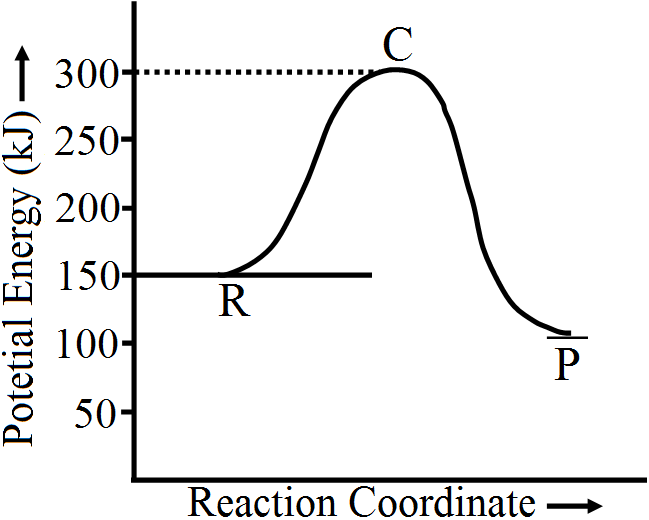
Answer the following questions on the basis of the given plot of potential energy vs reaction coordinate$:$
  1. What is the threshold energy for the reaction?
  2. What is the activation energy for forward reaction?
  3. What is the activation energy for backward reaction?
  4. What is enthalpy change for the forward reaction?
(a) Which is the salt of Mn which is isostructural to $KClO _4$ ?
(b) Explain the structure and magnetic properties of manganese and permanganate ions.