MCQ
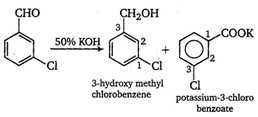
Predict the products in the given reaction.

- A
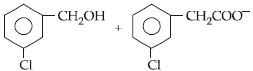
- B
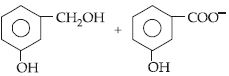
- ✓
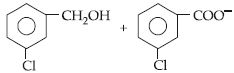
- D
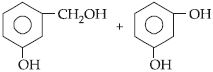
Generate a complete, print-ready paper with questions like this in minutes — across 16+ boards, with answer keys.
$(A)$ $\Lambda \stackrel{0}{ m }$ for electrolyte $A$ is obtained by extrapolation
$(B)$ For electrolyte B, vx $\Lambda m$ vs $\sqrt{ c }$ graph is a straight line with intercept equal to $\Lambda \stackrel{0}{ m }$
$(C)$ At infinite dilution, the value of degree of dissociation approach zero for electrolyte $B$.
$(D)$ $\Lambda \stackrel{0}{ m }$ for any electrolyte $A$ or $B$ can be calculated using $\lambda^{\circ}$ for individual ions.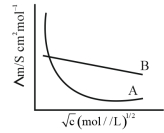
Reason : $1-$ Butene is more stable than $2-$ butene According to Saytzeff's rule, $2-$ butene should be the product which is more branched or substituted compound and hence, more stable than butene $-1$
$I ^{-}+ ClO _3^{-}+ H _2 SO _4 \longrightarrow Cl ^{-}+ HSO _4^{-}+ I _2$
The correct statement(s) in the balanced equation is/are:
$(A)$ Stoichiometric coefficient of $HSO _4^{-}$is 6 .
$(B)$ lodide is oxidized.
$(C)$ Sulphur is reduced.
$(D)$ $H _2 O$ is one of the products.