Question

Predict the reagents or the products in the following reaction sequence:
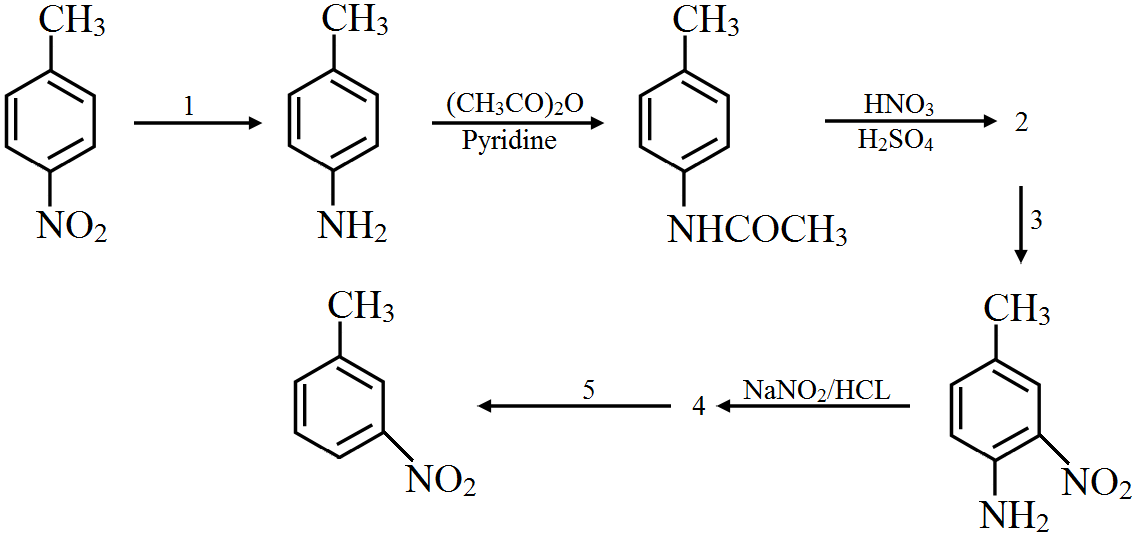
Answer

Get the step-by-step solution for this question inside the Vidyadip app.

Get the answer in the app

Need a full question paper?

Generate a complete, print-ready paper with questions like this in minutes — across 16+ boards, with answer keys.

Start Generating Free

Similar questions

After watching a programme on $TV$ about the presence of carcinogens $($cancer causing agents$)$ Potassium bromate and Potassium iodate in bread and other bakery products, Veena, a class $XII$ student, decided to make others aware about the adverse effects of these carcinogens in foods. She consulted the school principal and requested him to instruct the canteen contractor to stop selling sandwiches, pizzas, burgers and other bakery products to the students. The principal took an immediate action and instructed the canteen contractor to replace the bakery products with some proteins and vitamins$-$rich food like fruits, salads, sprouts, etc. The decision was welcomed by the parents and students.
After reading the above passage, answer the following questions:
  1. What are the values $($at least two$)$ displayed by Veena?
  2. Which polysaccharide component of carbohydrates is commonly present in bread?
  3. Write the two types of secondary structures of proteins.
  4. Give two examples of water soluble vitamins.
The reaction between A and B is first order with respect to A and zero order with respect to B. Fill in the blanks in the following table :
Experiment$[ A ] / mol L ^{-1}$$[ B ] / mol L ^{-1}$Initial rate
$/ mol$ $L ^{-1} min^{-1}$
I0.10.1$2.0 \times 10^{-2}$
II-0.2$4.0 \times 10^{-2}$
III0.40.4-
IV-0.2$2.0 \times 10^{-2}$
  1. Define the following terms:
  1. Ideal solution.
  2. Azeotrope.
  3. Osmotic pressure.
  1. A solution of glucose $(C_6H_{12}O_6)$ in water is labelled as $10\%$ by weight. What would be the molality of solution?
$($Molar mass of glucose $= 180\ g\ mol^{-1}).$
Describe the preparation of potassium permanganate. How does the acidified permanganate solution react with $(i)$ iron $(II)$ ions $(ii) SO_2$ and $(iii)$ oxalic acid? Write the ionic equations for the reactions.
Write short notes :
Acetylation
Explain the electrophilic substitution reactions of amine.
Describe a method for the identification of primary, secondary and tertiary amines. Also write chemical equations of the reaction involved.
  1. How is the variability in oxidation states of transition metals different from that of the $p-$block elements?
  2. Out of $Cu^+$ and $Cu^{2+}$, which ion is unstable in aqueous solution and why?
  3. Orange colour of $Cr_2O_7^{2–}$ ion changes to yellow when treated with an alkali. Why?
  4. Chemistry of actinoids is complicated as compared to lanthanoids. Give two reasons.
  1. How do you prepare:
  1. $K_2MnO_4$ from $MnO_2?$
  2. $Na_2Cr_2O_7$ form $Na_2CrO_4?$
  1. Account for the following:
  1. $Mn^{2+}$ is more stable than $Fe^{2+}$ towards oxidation to $+3$ state.
  2. The enthalpy of atomization is lowest for $Zn$ in $3d$ series of the transition elements.
  3. Actinoid elements show wide range of oxidation states.
A hydrocarbon $'A', (C_4H_8)$ on reaction with $HCl$ gives a compound $'B', (C_4H_9Cl)$, which on reaction with $1 \ mol$ of $NH_3$ gives compound $'C', (C_4H_{11}N)$. On reacting with $NaNO_2$ and $HCl$ followed by treatment with water, compound $'C\ '$ yields an optically active alcohol,$'D\ '$. Ozonolysis of $'A\ '$ gives $2$ mols of acetaldehyde. Identify compounds $'A\ '$ to $'D\ '$. Explain the reactions involved.
