Question
Prepare an imaginary specimen of a promissory note.
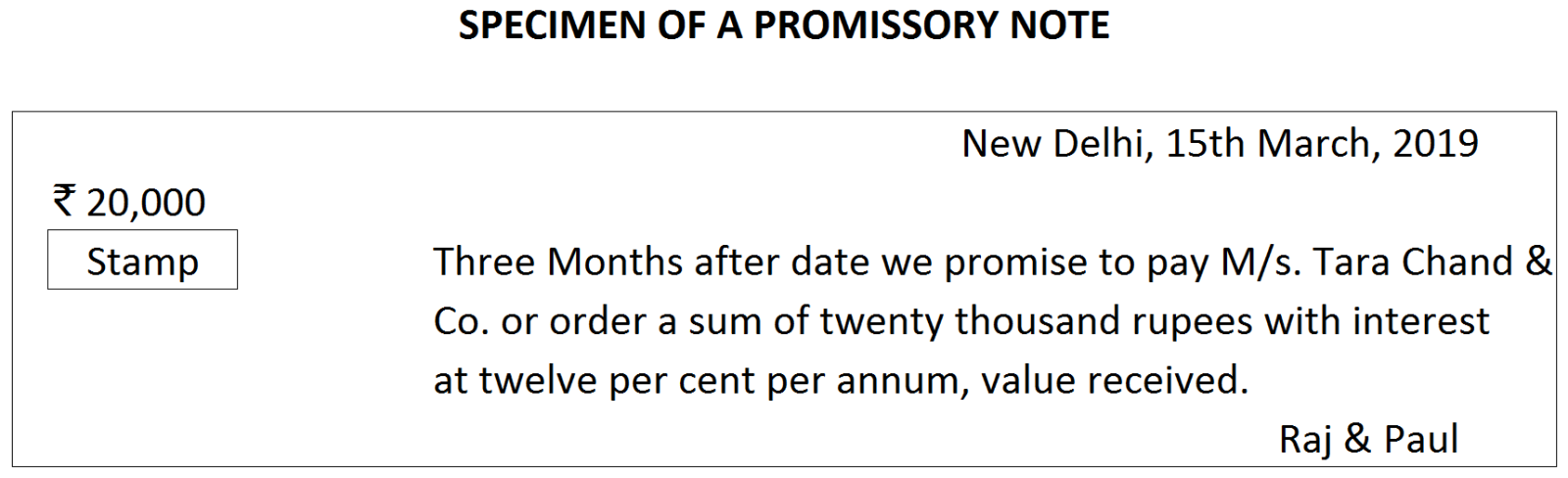
Answer

A Promissory Note has two parties namely:
  1. Maker: Maker is the person who makes the promise to pay the amount. It is a person who has availed the credit.
  2. Payee: Payee is the person to whom payment is to be made. It is a person who has granted the credit.

In the example, M/s. Raj & Paul is the maker or a promisor and M/s. Tara Chand & Co. is the payee.

Need a full question paper?

Generate a complete, print-ready paper with questions like this in minutes — across 16+ boards, with answer keys.

Start Generating Free

Similar questions

Rectify the following errors:
  1. Bought Radio for ₹ 1,000 for the proprietor was debited to General Expenses A/c.
  2. Bought goods from Mohan ₹ 2,000 was passed through the Sales Book, however, the account of Mohan was credited correctly.
  3. Wages due ₹ 1,500 has not been taken into account.
  4. Goods Returned by Kamal ₹ 240 has been debited to his account ₹ 420.
From the following particulars prepare a bank reconciliation statement of Govil as on 31st December, 2014.
Balance as per Pass Book on 31st December 2014 is ₹ 8,500. Cheques for ₹ 5,100 were issued during the month of December but of these cheques for ₹ 1,200 were presented in the month of January 2015 and one cheque for ₹ 200 was not presented for payment. Cheques and cash amounting to ₹ 4,800 were deposited in bank during December but credit was given for ₹ 3,800 only. A customer has deposited ₹ 800 into bank directly. The bank credited the merchant for ₹ 200 as interest and has debited him for ₹ 30 as bank charges for which there are no corresponding entries in Cash Book.
Give a definition of Bill of Exchange and give its four characteristics.
Distinguish between “Straight Line Method' and 'Written Down Value Method' of providing depreciation.
Prepare a Bank Reconciliation Statement in the books of Bharti as on 31st January 2017:
  1. Balance as per Pass Book as on 31st January, 2017 was ₹ 62,500.
  2. Cheque of ₹ 17,800 was issued by her on 28th January 2017 but this was not presented for payment till 31st January 2017.
  3. A cheque of ₹ 4,000 issued to Mr. Rahim, was taken in the cash column.
  4. A cheque of ₹ 15,000 was paid into bank but was omitted to be entered in the cash book.
  5. The bank has charged ₹ 55 as its commission and has allowed interest ₹ 50.
The balance of cash at bank as shown by the Cash Book of Pan & Co. on $31$st December, $2016,$ was $₹ 7,500.$ On checking the entries in the Cash Book with the Pass Book, it was ascertained that cheques of $₹ 500$ and $₹ 700$ respectively paid in on 30th December, were not credited until the $2$nd January following and three cheques of $₹ 600,\  ₹ 800$ and $₹ 1,200$ issued on the $28$th December were not presented until the $3$rd of January. There was a credit of $₹ 125$ in the Pass Book in respect of interest under date $31$st December, which was not entered in the Cash Book. There were also Bank Charges debited in the Pass Book amounting in all to $₹ 10$ which were not entered in the Cash Book. Prepare a Bank Reconciliation Statement as at $31$st December,$ 2016.$
From the following information, prepare an Analytical Petty Cash Book:
2019  
April 1 Received for cash payment 20,000
April 2 Paid for postage 1,600
April 5 Paid for stationery 1,000
April 8 Paid for advertisement 2,000
April 12 Paid for wages 800
April 16 Paid for carriage 600
April 20 Paid for conveyance 880
April 25 Paid for travelling expenses 3,200
April 27 Paid for postage 480
April 28 Paid for office cleaning 400
April 29 Paid for courier 800
April 30 Sent registered notice to landlord 190
From the following items prepare a Bank Reconciliation Statement on 31st May 2015:
  1. Bank balance as per Cash Book on 31st May 2015 ₹ 17,600.
  2. Cash and cheques totalling ₹ 36,000 were sent to bank during May but one cheque of ₹ 11,800 was shown in the Pass Book on 2nd June.
  3. As per instructions bankers have directly collected ₹ 4,100 from a customer but there is no mention of it in the Cash Book.
  4. Three cheques for ₹ 10,000, ₹ 12,000 and ₹ 4,800 respectively were drawn on 27th May but the cheque for ₹ 4,800 was encashed on 1st June.
  5. On 31st May bankers had debited ₹ 45 as bank charges but had intimated it on 3rd June.
  6. ₹ 16,200 were withdrawn from bank on 25th May but there is no entry for it in the Cash Book.
Prepare Bank Reconciliation Statement as on 31st January, 2017, if Cash Book of Mr. Sanjay showed a credit balance of ₹ 20,100.
  1. The bank had paid fire insurance premium of ₹ 550 which does not appear in the Cash Book.
  2. Cheques for ₹ 25,000 issued during January, but cheques for only ₹ 18,500 were presented for payment.
  3. Interest collected by bank ₹ 740.
  4. Cheques of ₹ 8,700 were deposited into bank, but cheques for ₹ 7,000 were cleared till 31st January, 2017.
  5. A customer deposited ₹ 620 directly into bank without informing Mr. Sanjay.
Journalise the following transactions:
  1. Goods destroyed by Fire for ₹ 5,000.
  2. Paid by cheque ₹ 25,000 as wages on installation of a Machinery.
  3. Issued a cheque in favour of M/s Parmatma Saran & Sons on account of purchase of goods ₹ 75,000.
  4. Goods sold costing ₹ 60,000 to M/s Kalu Sons at an invoice price 10% above cost less 5% Trade discount.