MCQ
Pressure head in Bernoulli's equation is
  • A
    $\frac{{P\rho }}{g}$
  • $\frac{{P}}{\rho g}$
  • C
    $\rho g$
  • D
    $P\rho g$

Answer

Correct option: B.
$\frac{{P}}{\rho g}$
b
Bernoulli Equation is principally conservation of energy equation in fluids, relating the pressure, velocity of fluid flowing and gravitational potential of liquid at some point.

It is given as

$\frac{P}{\rho g}+h+\frac{1}{2} \frac{v^{2}}{g}=$ constant

where $\frac{P}{\rho g}$ is the pressure head.

Need a full question paper?

Generate a complete, print-ready paper with questions like this in minutes — across 16+ boards, with answer keys.
Start Generating Free

Similar questions

The variation of density of a cylindrical thick and long rod, is $\rho  = {\rho _0}\frac{{{x^2}}}{{{L^2}}}$ , then position of its centre of mass from $x = 0$ end is
A current carrying rectangular coil is placed in a uniform magnetic field. In which orientation, the coil will not tend to rotate
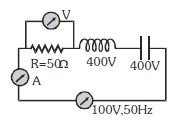
In given $LCR$ circuit, the voltage across the terminals of a resistance and current will be
Let $T_1$ and $T_2$ be the time periods of two springs $A$ and $B$ when a mass $m$ is suspended from them separately. Now both the springs are connected in parallel  and same mass $m$ is suspended with them. Now let $T$ be the time period in this position. Then
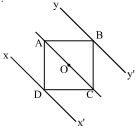
Let $I_1, I_2$ and $I_3$ be the moment of inertia of a uniform square plate about axes $AOC, xDx'$ and $yBy'$ respectively as shown in the figure. The moments of inertia of the plate $I_1 : I_2 : I_3$ are in the ratio.
In the Young’s double slit experiment, for which colour the fringe width is least
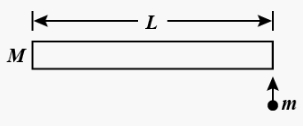
A stick of length $l$ and mass $M$ lies on a frictionless horizontal surface on which it is free to move in any way. A ball of mass $m$ moving with speed $v$ collides elastically with the stick as shown in the figure. If after the collision ball comes to rest, then what should be the mass of the ball
A charge $Q$ is distributed over three concentric spherical shell of radii $a, b, c (a < b < c)$ such that their surface charge densities are equal to one another. The total potential at a point at distance $r$ from their common centre, where $r < a$, would be
A wire of length $30\,cm$, stretched between rigid supports, has it's $n^{\text {th}}$ and $(n+1)^{\text {th}}$ harmonics at $400\,Hz$ and $450\; Hz$, respectively. If tension in the string is $2700\,N$, it's linear mass density is.........$kg/m$.
Which of the following measurement is more accurate?