MCQ
Pressure head in Bernoulli's equation is
  • A
    $\frac{{P\rho }}{g}$
  • $\frac{{P}}{\rho g}$
  • C
    $\rho g$
  • D
    $P\rho g$

Answer

Correct option: B.
$\frac{{P}}{\rho g}$
b
Bernoulli Equation is principally conservation of energy equation in fluids, relating the pressure, velocity of fluid flowing and gravitational potential of liquid at some point.

It is given as

$\frac{P}{\rho g}+h+\frac{1}{2} \frac{v^{2}}{g}=$ constant

where $\frac{P}{\rho g}$ is the pressure head.

Need a full question paper?

Generate a complete, print-ready paper with questions like this in minutes — across 16+ boards, with answer keys.
Start Generating Free

Similar questions

Which of the following statements are true in case when two water drops collapse and make a bigger drop
Which of the following equation does not represent a simple harmonic motion
A light rope is wound around a hollow cylinder of mass $5\,kg$ and radius $70\,cm$. The rope is pulled with a force of $52.5\,N$. The angular acceleration of the cylinder will be.....$ {rad \,s}{ }^{-2}$.
A ball of mass $50 \,g$ is dropped from a height of $20 \,m$. A boy on the ground hits the ball vertically upwards with a bat with an average force of $200 \,N$, so that it attains a vertical height of $45 \,m$. The time for which the ball remains in contact with the bat is ........... of a second [Take $g=10 \,m / s ^2$ ]
Which one of the following quantities has dimensions different from the remaining three
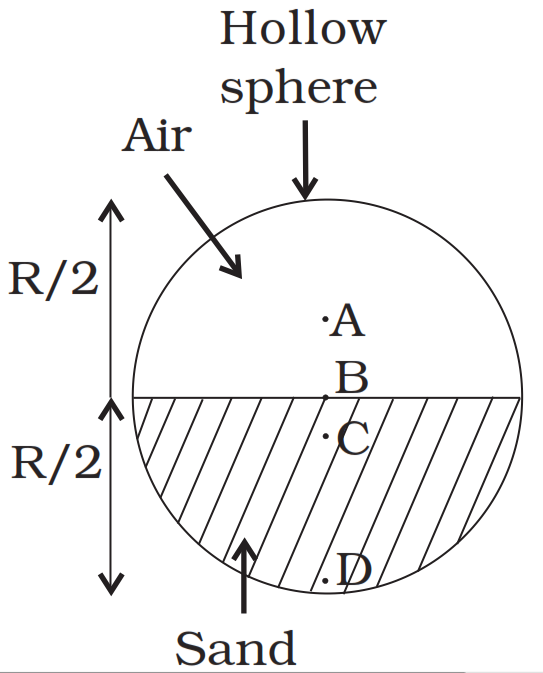
Which of the following points is the likely position of the centre of mass of the system shown in?

$STATEMENT-1$ For an observer looking out through the window of a fast moving train, the nearby objects appear to move in the opposite direction to the train, while the distant objects appear to be stationary. and

$STATEMENT-2$ If the observer and the object are moving at velocities $\vec{V}_1$ and $\vec{V}_2$ respectively with reference to a laboratory frame, the velocity of the object with respect to the observer is $\overrightarrow{\mathrm{V}}_2-\overrightarrow{\mathrm{V}}_1$.

The loss in weight of a solid when immersed in a liquid at $0^o C$ is $W_0$ and at $t^o C$ is $W$. If cubical coefficient of expansion of the solid and the liquid by $\gamma_s$ and $\gamma_l$ respectively, then $W$ is equal to :
A particle is moving along a straight line parallel to $x-$ axis with constant velocity. Its angular momentum about the origin
Two particles of masses $m_1$ and $m_2$ $(m_1 > m_2)$, initially at rest, move towards each other under an inverse square law force of attraction. Pick out the correct statement about the centre of mass $(CM)$ of the system