MCQ
Primary nitro compounds when react with $HN{O_2}$ forms crystalline solids which on treatment with $NaOH$ gives
  • Red solution
  • B
    Blue solution
  • C
    White precipitate
  • D
    Yellow colouration

Answer

Correct option: A.
Red solution
a
(a)$\mathop {R - C{H_2} - N{O_2}}\limits_{{1^o}{\text{nitro}}} {\mkern 1mu} \xrightarrow{{HN{O_2}}}$ $\mathop {\begin{array}{*{20}{c}}
  {R - C - N{O_2}} \\ 
  {||\,\,\,\,\,\,} \\ 
  {\,\,\,\,\,\,\,N - OH} 
\end{array}}\limits_{{\text{Nitroloic acid}}} {\mkern 1mu} $  $\xrightarrow{{NaOH}}$ $\mathop {\begin{array}{*{20}{c}}
  {R - C - N{O_{2\,}}\,\,\,\,\,\,\,\,\,\,\,\,\,} \\ 
  {||\,\,\,\,\,\,\,\,\,\,\,\,\,\,\,\,\,\,\,\,} \\ 
  {\,\,\,N - {O^ - }N{a^ + }} 
\end{array}}\limits_{{\text{(Blood red)}}} {\mkern 1mu} $

Need a full question paper?

Generate a complete, print-ready paper with questions like this in minutes — across 16+ boards, with answer keys.

Start Generating Free

Similar questions

Only iodine forms hepta-fluoride $IF_7$ , but chlorine and bromine give penta-fluorides. The reason for this is;
The enthalpy of formation of ethane $\left(\mathrm{C}_2 \mathrm{H}_6\right)$ from ethylene by addition of hydrogen where the bondenergies of $\mathrm{C}-\mathrm{H}, \mathrm{C}-\mathrm{C}, \mathrm{H}-\mathrm{H}$ are $414 \mathrm{~kJ}, 347 \mathrm{~kJ}$, $615 \mathrm{~kJ}$ and $435 \mathrm{~kJ}$ respectively is -. . . . . . . . .$\mathrm{kJ}$.
In which of the following options the order of arrangement does not agree with the variation of property indicated against it ?
The 'spin only' magnetic moment value of $\mathrm{MO}_4{ }^{2-}$ is . . . . . BM. (Where $\mathrm{M}$ is a metal having least metallic radii. among $\mathrm{Sc}, \mathrm{Ti}, \mathrm{V}, \mathrm{Cr}, \mathrm{Mn}$ and $\mathrm{Zn}$ ).

(Given atomic number: $\mathrm{Sc}=21, \mathrm{Ti}=22, \mathrm{~V}=23$, $\mathrm{Cr}=24, \mathrm{Mn}=25$ and $\mathrm{Zn}=30)$

Which of the following metal is expected to have the highest third ionization enthalpy?
For the reaction ${H_2}(g) + B{r_2}(g) \to 2HBr(g)$, the experimental data suggest, rate $ = K[{H_2}]{[B{r_2}]^{1/2}}$. The molecularity and order of the reaction are respectively
The electronic configuration of three elements $A,B$ and $C$ are given below. The bond between $B$ and $C$ will be

$A : 1s^2\, 2s^2\, 2p^6$
$B : 1s^2\, 2s^2\, 2p^6\, 3s^2\, 3p^3$
$C : 1s^2\, 2s^2\, 2p^6\, 3s^2\, 3p^5$
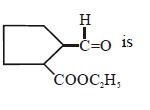
Correct name of
$P_4O_{10}$ has short and long $P-O$ bonds. The number of short $P-O$ bond in this compound is
The total energy of the electron in the hydrogen atom in the ground state is $-13.6\, eV.$ What is the stopping potential : ............ $\mathrm{volts}$