MCQ
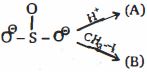
Product $(A)$ and $(B)$ in above reaction is
  • A
    $\begin{array}{*{20}{c}}
      {O\,\,\,\,\,\,} \\ 
      {||\,\,\,\,\,\,\,} \\ 
      {{O^ - } - S - O - H,} 
    \end{array}\begin{array}{*{20}{c}}
      {O\,\,\,\,\,\,\,\,\,\,} \\ 
      {||\,\,\,\,\,\,\,\,\,\,\,} \\ 
      {{O^ - } - S - O - C{H_3}} 
    \end{array}$
  • $\begin{array}{*{20}{c}}
      {O\,\,\,\,\,\,\,\,\,\,} \\ 
      {||\,\,\,\,\,\,\,\,\,\,\,} \\ 
      {{O^ - } - S - O - H,} 
    \end{array}$ $\begin{array}{*{20}{c}}
      \,\,\,\,{O\,\,} \\ 
      \,\,\,\,{||\,\,} \\ 
      {{O^ - } - {}_ \oplus S - C{H_3}} \\ 
      \,\,{|\,\,\,} \\ 
     \,\, {{O^ - }\,} 
    \end{array}$
  • C
    $\begin{array}{*{20}{c}}
      {O\,\,\,\,\,\,\,\,\,\,\,\,\,\,\,} \\ 
      {||\,\,\,\,\,\,\,\,\,\,\,\,\,\,\,\,} \\ 
      {{O^ - } - S - O - C{H_3},} 
    \end{array}$ $\begin{array}{*{20}{c}}
      {\,\,\,\,\,\,\,\,O\,\,} \\ 
      {\,\,\,\,\,\,\,\,||\,\,} \\ 
      {{O^\Theta } - {}^ \oplus S - H} \\ 
      {\,\,\,\,\,\,|} \\ 
      {\,\,\,\,\,\,\,\,\,\,\,C{H_3}} 
    \end{array}$
  • D
    $\begin{array}{*{20}{c}}
      {\,\,\,\,\,\,\,\,O\,\,} \\ 
      {\,\,\,\,\,\,\,\,||\,\,} \\ 
      {{O^ - } - {}^ \oplus S - O} \\ 
      {\,\,\,\,\,\,|} \\ 
      {\,\,\,\,H} 
    \end{array},\begin{array}{*{20}{c}}
      {\,\,O\,\,} \\ 
      {\,\,||\,\,} \\ 
      {{O^ - } - S - {O^ - }} \\ 
      {||} \\ 
      {\,\,\,\,\,C{H_3}} 
    \end{array}$
Answer

Correct option: B.
$\begin{array}{*{20}{c}}
  {O\,\,\,\,\,\,\,\,\,\,} \\ 
  {||\,\,\,\,\,\,\,\,\,\,\,} \\ 
  {{O^ - } - S - O - H,} 
\end{array}$ $\begin{array}{*{20}{c}}
  \,\,\,\,{O\,\,} \\ 
  \,\,\,\,{||\,\,} \\ 
  {{O^ - } - {}_ \oplus S - C{H_3}} \\ 
  \,\,{|\,\,\,} \\ 
 \,\, {{O^ - }\,} 
\end{array}$
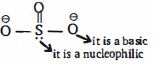
b
(Sulphur is better nucleophile than oxygen.) (But oxygen is better base than  sulphur)

Need a full question paper?

Generate a complete, print-ready paper with questions like this in minutes — across 16+ boards, with answer keys.

Start Generating Free

Similar questions

Appropriate reducing agent for the following conversion is-

$\begin{array}{*{20}{c}}
  {\,\,\,\,\,\,\,\,\,\,\,\,\,\,\,\,\,\,\,\,\,\,\,\,\,\,\,\,\,\,\,\,\,\,\,\,\,\,\,\,\,\,\,O} \\ 
  {\,\,\,\,\,\,\,\,\,\,\,\,\,\,\,\,\,\,\,\,\,\,\,\,\,\,\,\,\,\,\,\,\,\,\,\,\,\,\,\,\,\,\,||} \\ 
  {C{H_2} = CH - C{H_2} - C - H} 
\end{array} \to C{H_3} - C{H_2} - C{H_2} - C{H_2}OH$

The magnetic moment of the complex $[Ni (NH_3)_6] Cl_2$ is
Holme's signals can be obtained by using
Which of the following order is CORRECT
Given

  Reaction    Energy Change (in $kJ$ )
  $Li(s) \to  Li(g)$    $161$
  $Li(g) \to  Li^+(g)$    $520$
  $\frac {1}{2}F_2(g)\,\to F(g)$    $77$
  $F(g) + e^- \to F^-(g)$   (Electron gain enthalpy)
  $Li^+ (g) + F^-(g) \to  LiF(s)$    $-1047$
  $Li (s) + \frac {1}{2}F_2(g)\to LiF(s)$    $-617$

Based on data provided, the value of electron gain enthalpy of fluorine would be.....$kJ\,mol^{-1}$

Comment on optical activity of the products. They are
For the reaction $2 \mathrm{NO}_{2}(\mathrm{~g}) \rightleftharpoons \mathrm{N}_{2} \mathrm{O}_{4}(\mathrm{~g})$, when $\Delta \mathrm{S}=-176.0\, \mathrm{JK}^{-1}$ and $\Delta \mathrm{H}=-57.8\, \mathrm{~kJ}\, \mathrm{~mol}^{-1}$, the magnitude of $\Delta \mathrm{G}$ at $298\, \mathrm{~K}$ for the reaction is $......\,\mathrm{kJ} \mathrm{mol}^{-1} .$ (Nearest integer)
In the Libermann's nitroso reaction, sequential changes in the colour of phenol occurs as
The number of $P-O$ bonds in $P_4O_6$ is:
The molal elevation constant is the ratio of the elevation in B.P. to