MCQ
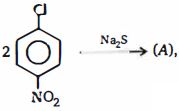
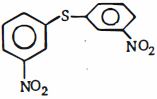
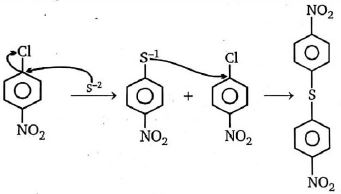
Product $(A)$ in this reaction is
- A
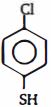
- ✓
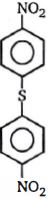
- C
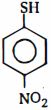
- D
Generate a complete, print-ready paper with questions like this in minutes — across 16+ boards, with answer keys.

| LIST - I (Molecules/ion) | LIST - II (Hybridisation of central atom) | ||
| A. | PF_(5) | I | dsp^(2) |
| B. | SF_(6) | II. | sp^(3)d |
| C. | Ni(CO)_(4) | III. | sp^(3)d^(2) |
| D. | [PtCl_(4)]^(2-) | IV. | sp^(3) |
Statement $I :$ The nucleophilic addition of sodium hydrogen sulphite to an aldehyde or a ketone involves proton transfer to form a stable ion.
Statement $II :$ The nucleophilic addition of hydrogen cyanide to an aldehyde or a ketone yields amine as final product.
In the light of the above statements, choose the most appropriate answer from the options given below :
$\mathrm{A}+\mathrm{B} \rightleftharpoons 2 \mathrm{C}$
the value of equilibrium constant is $100$ at $298\, \mathrm{~K}$. If the initial concentration of all the three species is $1\, \mathrm{M}$ each, then the equilibrium concentration of $\mathrm{C}$ is $\mathrm{X} \times 10^{-1} \,\mathrm{M}$. The value of $\mathrm{x}$ is $.....$ (Nearest integer)