MCQ
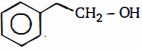
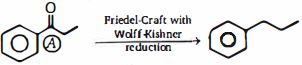
Product $(B)$ in this reaction is

  • A


  • C

  • D

Answer

Correct option: B.

b

Need a full question paper?

Generate a complete, print-ready paper with questions like this in minutes — across 16+ boards, with answer keys.

Start Generating Free

Similar questions

Which of the following vitamin is water soluble?
$17.4\%$ $(W/V)$ of potassium sulphate $(mol.\, wt. = 174)$ is isotonic with $4\%\, (W/V)$ aqueous solution of $NaOH$. If $NaOH$ is $100\%$ ionised, the degree of ionisation of potassium sulphate is ........... $\%$.
For the reaction in equilibrium

$2NOB{r_{(g)\,}}\, \rightleftharpoons \,2N{O_{(g)}}\, + \,B{r_{2(g)}}$

if ${P_{B{r_2}}}$ is $\frac {P}{4}$ At equilibrium and $P$ is total pressure then calculate $\frac {P}{K_P}.$
Dehydration of $2-$ butanol yield
One mole of an ideal gas is expanded isothermally and reversibly to half of its initial pressure. $\Delta S$ for the process in $J\, K^{- 1}\, mol^{- 1}$ is $[ln\, 2\, = 0.693$ and $R\, = 8.314,\, J/(mol\, K)]$
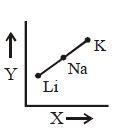
If coordinate $'X'$ is atomic number then select best for $'Y'$ coordinate 
The energies of activation for forward and reverse reactions for $A_2 + B_2 \rightleftharpoons  2AB$ are $180\, kJ\, mol^{-1}$ and $200 \,kJ\, mol^{-1}$  respectively. The presence of a catalyst lowers the activation energy of both (forward and reverse) reactions by $100\, kJ\,mol^{-1}.$ The enthalpy change of the reaction $(A_2 + B_2 \rightarrow 2AB)$ in the presence of a catalyst will be ( in $kJ\, mol^{-1}$)
Isobutene, in the presence of $H_2SO_4$, forms a mixture of two isomeric alkene  $(C_8H_{16})$. The major alkene is
${H_3}C - \mathop {\mathop {C = }\limits_{|\,\,\,\,\,\,} }\limits_{Cl\,\,} CH - \mathop {\mathop {CH - }\limits_{|\,\,\,\,\,\,\,\,\,\,\,} }\limits_{C{H_3}\,\,} C{H_3}$
Which reaction is used for the preparation of $\alpha - $ Bromoacetic acid ?