MCQ
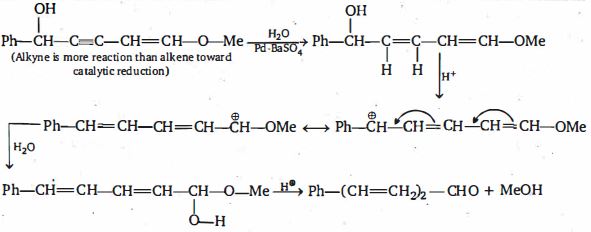
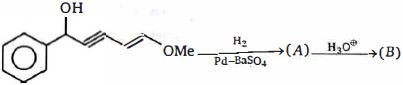
Product $(B)$ is
  • A
    $\begin{matrix}
       OH\,\,\,\,\,\,\,\,\,\,\,\,\,\,\,\,\,\,\,  \\
       |\,\,\,\,\,\,\,\,\,\,\,\,\,\,\,\,\,\,\,\,\,\,\,\,\,\,\,  \\
       Ph-CH-CH=CH-  \\
    \end{matrix}\begin{matrix}
       \,\,\,\,\,O  \\
       \,\,\,\,\,||  \\
       C{{H}_{2}}-C-H  \\
    \end{matrix}$
  • B
    $Ph -CH = CH -CHO$
  • $Ph - (CH = CH)_2 -CHO$
  • D
    $Ph - (CH = CH)_3 -CHO$

Answer

Correct option: C.
$Ph - (CH = CH)_2 -CHO$
c

Need a full question paper?

Generate a complete, print-ready paper with questions like this in minutes — across 16+ boards, with answer keys.

Start Generating Free

Similar questions

In Niobium $(Z = 41)$ the number of electrons with $m = -1$ will be
Which bond angle $\theta $ gives maximum dipole moment for triatomic molecule  $XY_2$
Under normal condition which of the following electronic configuration is able to form dipositive ion
Given

$E^o_{Cl_2/Cl^-} = 1.36\,V,$   $E^o_{Cr^{3+}/Cr}= -0.74\,V,$

$E^o_{Cr_2/O_7^{2-}/Cr^{3+}}=1.33\,V,$   $E^o_{MnO^-_4/Mn^{2+}} = 1.51\,V$

Among the following, the strongest reducing agent is

Three molecules of acetone in the presence of dry $HCl$ form
The hypothetical reaction : $2A + B \to C + D$ is catalyzed by $E$ as indicated in the possible mechanism below -

Step$-1$ : ${\text{A  +  E }} \rightleftharpoons AE$ (fast)

Step$-2$ :${\text{AE  +  A }} \to {A_2} + E$ (slow)

Step$-3$ :${{\text{A}}_2}{\text{ +  B }} \to {\text{D}}$ (fast)

what rate law best agrees with this mechanism

Given below are two statements :

Statement $I$ : The higher oxidation states are more stable down the group among transition elements unlike p-block elements.

Statement $II$ : Copper can not liberate hydrogen from weak acids.

In the light of the above statements, choose the correct answer from the options given below :

Which of the following reaction is not a redox reaction ?
In the sulphonation, acetylation and formylation of benzene the group of effective electrophiles would be :
${A^{ 2+}}_{(aq.)} + 2{e^ - } \to A(s)$  ; $E = 0.8\ Volt$

${B^{3 + }}_{(aq.)} + 3{e^ - } \to B(s)$  ; $E = 0.6\ Volt$

Using above information find the ion which will be deposited first at cathode if solution containing $A_{(aq.)}^{2 + }$ & $B_{(aq.)}^{ 3+ }$ is electrolysed