MCQ
product $(B)$ is
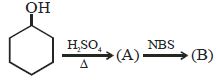
  • A


  • C

  • D
    None

Answer

Correct option: B.

b

Need a full question paper?

Generate a complete, print-ready paper with questions like this in minutes — across 16+ boards, with answer keys.

Start Generating Free

Similar questions

One mole of an ideal gas at $300\, K$ is expanded isothermally from an initial volume of $1$ litre to $10$ litres. The value of $\Delta E$ for this process is $(R = 2\, cal\, mol^{-1}\, K^{-1})$
The increasing order of magnetism of

$(I)$ $MnSO_4.4H_2O$              $(II)$ $FeSO_4.7H_2O$

$(III)$ $NiSO_4.6H_2O$              $(IV)$ $CuSO_4.5H_2O$

$'X'$ melts at low temperature and is a bad conductor of electricity in both liquid and solid state. $X$ is
Which of the following sets of At. No. corresponds to element of group $16$
The co-ordination number of copper in cuprammonium sulphate is
Which of the following compound will give $3, 5-$ dimethyl $-6-$ oxo octanal on reductive Ozonolysis
Which alloy contains $Cu, Sn$  and  $Zn$
The electron affinities of halogens are $F = 322,Cl = 349, Br = 324, I = 295\, kJ\, mol^{-1}.$The higher value for $Cl$ as compared to that of $F$ is due to :-
$\mathop {C{H_2} = CH - CH = CH{ - ^ \oplus }N{H_3};}\limits_{(I)} \,\,\mathop {{\,^ \oplus }C{H_2}-CH = CH{ - ^\circleddash }CH{ - ^ \oplus }N{H_3}}\limits_{(II)} $

$\mathop {^ \oplus C{H_2} - CH = CH - CH = N{H_3}}\limits_{(III)} $

Which of these structures is not a valid canonical structure ?

$\mathrm{CH}_2=\mathrm{CH}-\mathrm{CH}=\mathrm{CH}-{ }^{\oplus} \mathrm{NH}_3 ;{ }^{\oplus} \mathrm{CH}_2-\mathrm{CH}=$

Consider the data given below for hypothetical reaction $A \to X$

$Time  (sec)$                     Rate $(mol\,  L^{-1} sec.^{-1})$

$0$                                      $1.60 \times 10^{-2}$

$10$                                    $1.60 \times 10^{-2}$

$20$                                    $1.60 \times 10^{-2}$

$30$                                    $1.60 \times 10^{-2}$

From the above data, the order of reaction is