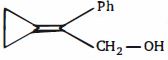
MCQ
Product $(B)$ is
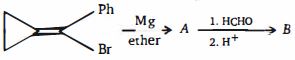
  • A

  • $Ph - C \equiv C - CH_2 - CH_2 -CH_2 -OH$
  • C
    $Ph - C \equiv C - CH_2 -CH_2 -OH$
  • D
    $Ph - CH_2 -C \equiv C - CH_2 -CH_2 -OH$

Answer

Correct option: B.
$Ph - C \equiv C - CH_2 - CH_2 -CH_2 -OH$
b

Need a full question paper?

Generate a complete, print-ready paper with questions like this in minutes — across 16+ boards, with answer keys.

Start Generating Free

Similar questions

A current being passed for two hour through a solution of an acid liberating $11.2$ litre of oxygen at $NTP $ at anode. What will be the amount of copper deposited at the cathode by the same current when passed through a solution of copper sulphate for the same time ........... $\mathrm{g}$
Which statement is correct about halogens
Two solutions of $KNO_3$ and $CH_3COOH$ are prepared separately. Molarity of both is $0.1\, M$ and osmotic pressures are $P_1$ and $P_2$ respectively. The correct relationship between the osmotic pressures is :-
Which of the Phosphorus oxoacid can create silver mirror from $AgNO _3$ solution ?
When Propanoic acid is treated with aqueous sodium bicarbonate, CO2 is released. The carbon of CO2 comes from :
The compound which gives the most stable carbonium on dehydration is
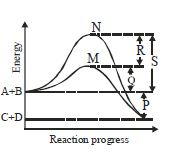
${\text{A(g)  +  B(g) }} \rightleftharpoons {\text{C(g)  +  D(g)}}$ 

The curves $M$ and $N$ represent the variation of energy with reaction coordinate for the reaction in absence and presence of catalyst

Which value represents the activation energy $(E_a)$ for the backward reaction in the presence of catalyst
The following results were obtained during kinetic studies of the reaction $2A+B$ $\to$ products

Experiment

$[A]$

(in $mol\, L^{-1})$

$[B]$

(in $mol\, L^{-1})$

Initial rate of reaction

(in $mol\, L^{-1}\,min^{-1})$

$I$ $0.10$ $0.20$ $6.93 \times {10^{ - 3}}$
$II$ $0.10$ $0.25$ $6.93 \times {10^{ - 3}}$
$III$ $0.20$ $0.30$ $1.386 \times {10^{ - 2}}$

The time(in minutes) required to consume half of $A$ is

Identify the major product formed in the following sequence of reactions
Thermal decomposition of a compound is of first order. If $50\%$ of a sample of this compound is decomposed in $120\,\min$, then how long will it take $90\%$ of the compound to decompose ? ........ $\min.$