MCQ
Product ($B$) will
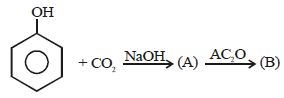
- A
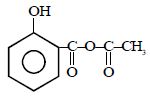
- B
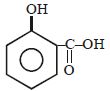
- C
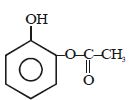
- ✓
Generate a complete, print-ready paper with questions like this in minutes — across 16+ boards, with answer keys.
$A\,\xrightarrow{{{k_1}}}B$ ${k_1}\, = \,1.26\, \times \,{10^{ - 4}}\,{S^{ - 1}}$
$A\,\xrightarrow{{{k_2}}}C$ ${k_2}\, = \,3.8\, \times \,{10^{ - 5}}\,{S^{ - 1}}$
$A$. The stability of the hydrides decreases in the order $\mathrm{NH}_3>\mathrm{PH}_3>\mathrm{AsH}_3>\mathrm{SbH}_3>\mathrm{BiH}_3$
$B$. The reducing ability of the hydrides increases in the order $\mathrm{NH}_3<\mathrm{PH}_3<\mathrm{AsH}_3<\mathrm{SbH}_3<\mathrm{BiH}_3$
$C$. Among the hydrides, $\mathrm{NH}_3$ is strong reducing agent while $\mathrm{BiH}_3$ is mild reducing agent.
$D$. The basicity of the hydrides increases in the order $\mathrm{NH}_3<\mathrm{PH}_3<\mathrm{AsH}_3<\mathrm{SbH}_3<\mathrm{BiH}_3$Choose the most appropriate from the option given below:
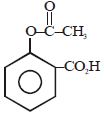
the product $A$ is