MCQ
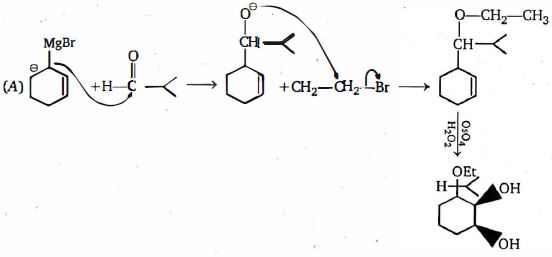
Product $(C)$ is

- A
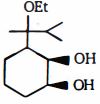
- ✓
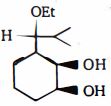
- C
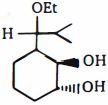
- DBoth $(a)$ and $(b)$
Generate a complete, print-ready paper with questions like this in minutes — across 16+ boards, with answer keys.
| List-$I$ (Elements) | List-$II$(Properties in their respective groups) |
| $A$ $\mathrm{Cl}, \mathrm{S}$ | $I$ Elements with highest electronegativity |
| $B$ $\mathrm{Ge}, \mathrm{As}$ | $II$ Elements with largest atomic size |
| $C$ $\mathrm{Fr}, \mathrm{Ra}$ | $III$ Elements which show properties of both metals and non metal |
| $D$ $\mathrm{F}, \mathrm{O}$ | $IV$ Elements with highest negative electron gain enthalpy |
Choose the correct answer from the options given below :
$\gamma_{1} A +\gamma_{2} B \rightarrow \gamma_{3} C +\gamma_{4} D$
Concentration of $C$ changes from $10\, mmol$ appearance of $D$ is $1.5$ times the rate of disappearance of $B$ which is twice the rate of disappearance $A$. The rate of appearance of $D$ has been experimentally determined to be $9 \,m\,mol$ $dm ^{-3} s ^{-1}$. Therefore the rate of reaction is $......\,m\,mol\, dm ^{-3} \,s ^{-1}$. (Nearest Integer)
${{C}_{6}}{{H}_{5}}OH\xrightarrow{NaOH}(A)$ $\mathop {\xrightarrow{{\;C{O_2}\;\;\;\;\;\;\;\;\;\;\;\;}}}\limits_{140\,^oC,\;(4 - 7\,)} (B)$ $\xrightarrow{{HCl}}(C),$