MCQ
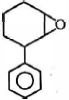
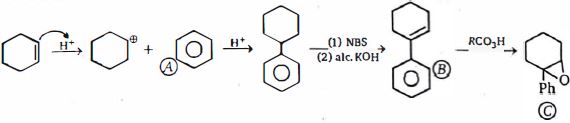
Product $(C)$ is

  • A


  • C

  • D

Answer

Correct option: B.

b
$(b)$ $(A)$ Friedel-Craft alkylation 
          $(B)$ Alkylic substitution with $E_2$
          $(C)$ Priliaschaeve reaction.

Need a full question paper?

Generate a complete, print-ready paper with questions like this in minutes — across 16+ boards, with answer keys.
Start Generating Free

Similar questions

In the electrothermal process, the compound displaced by silica from calcium phosphate is:
What is the chief product obtained when $n-$ butane is treated with bromine in the presence of light at ${130\,^o}C$
In which of the following groups of iodine compounds shows increasing order of oxidation states :
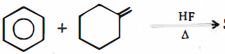
Suitable product of this reaction is
How does the surface tension of a liquid vary with increase in temperature?
Calculate $\Delta H_f^o$ for $UBr_4$  from the $\Delta G^o$ of reaction and the $S^o$ values :- $U(s) + 2Br_2(\ell ) \to  UBr_4(s);\,\,$ $\,\,\Delta G^o =\,-\,788.6\,\,kJ;$
$S^o (J/K-mol)\,\, 50.3, 152.3, 242.6$ .....$kJ/mol$
Largest in size out of $Na^+ , Ne$ and $F^-$ is
For a thermodynamics process to be reversible, the temperature difference between hot body and the working substance should be :
Which of the following best describe the given statement "an atom or group of atoms joined in a specific manner which is responsible for the characteristic chemical properties of the organic compounds?
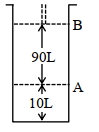
Consider the figure provided.

$1 \mathrm{~mol}$ of an ideal gas is kept in a cylinder, fitted with a piston, at the position $\mathrm{A}$, at $18^{\circ} \mathrm{C}$. If the piston is moved to position $B$, keeping the temperature unchanged, then ' $x$ ' $L$ atm work is done in this reversible process.

$\mathrm{x}=$ . . . . . . $\mathrm{L} \mathrm{atm.} \mathrm{(nearest} \mathrm{integer)}$

[Given : Absolute temperature $={ }^{\circ} \mathrm{C}+273.15$, $\left.\mathrm{R}=0.08206 \mathrm{~L} \mathrm{~atm} \mathrm{~mol}^{-1} \mathrm{~K}^{-1}\right]$