MCQ
Product; Comment upon optical activity of the product
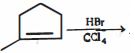
  • A
    Racemic mixture
  • B
    Diastereomers
  • C
    Meso
  • Optically inactive due to absence of chiral center
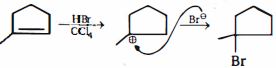
Answer

Correct option: D.
Optically inactive due to absence of chiral center
d

Need a full question paper?

Generate a complete, print-ready paper with questions like this in minutes — across 16+ boards, with answer keys.

Start Generating Free

Similar questions

Consider the reactions given below. On the basis of these reactions find out which of the algebric relations given in options $(i)$ to $(iv)$ is correct?
  1. $\text{C}(\text{g})+4\text{H}(\text{g})\rightarrow\text{CH}_4(\text{g});\Delta_\text{r}\text{H}=\text{x}\text{kJ}\ \text{mol}^{-1}$
  2. $\text{C}(\text{graphite,s})+2\text{H}_2(\text{g})\rightarrow\text{CH}_4(\text{g});\Delta_\text{r}\text{H}=\text{y}\text{kJ}\ \text{mol}^{-1}$​​​​
Which of the following statements is correct
Solid $C{H_4}$ is
Melting point of a solid is $x\,K$ and its latent heat of fusion is $600\,cal\,mol^{-1}.$ The entropy change for fusion of $1\,mol$ solid is $2\,cal\,mol^{-1}\,K^{-1}$. The value of $x$ will be......$K$
Gases possess characteristic critical temperature which depends upon the magnitude of intermolecular forces between the particles. Following are the critical temperatures of some gases.
Gases
$\ce{H_2}$
$\ce{He}$
$\ce{O_2}$
$\ce{n_2}$
Critical temperature in Kelvin
$33.2$ $5.3$ $154.3$ $126$
From the above data what would be the order of liquefaction of these gases? Start writing the order from the gas liquefying first.
Under a given set of experimental conditions, with increase in the concentration of the reactants, the rate of a chemical reaction
Hydrocarbon $(A)$ reacts with bromine by substitution to form an alkyl bromide which by Wurtz reaction is converted to gaseous hydrocarbon contalning less than four carbon atoms. $(\mathrm{A})$ is
The $IUPAC$ name of $\begin{matrix}
   \,\,\,\,\,\,\,\,\,\,\,\,\,\,\,\,\,\,\,\,\,\,\,\,\,\,\,\,\,\,\,\,\,\,\,\,\,\,\,\,\,\,\,\,\,\,\,\,\,\,\,\,\,\,\,\,\,C{{H}_{3}}\,  \\
   \,\,\,\,\,\,\,\,\,\,\,\,\,\,\,\,\,\,\,\,\,\,\,\,\,\,\,\,\,\,\,\,\,\,\,\,\,\,\,\,\,\,\,\,\,\,\,\,\,\,|  \\
   C{{H}_{3}}-C{{H}_{2}}-CH-CH-C-C{{H}_{3}}  \\
   \,\,\,\,\,\,\,\,\,\,\,\,\,\,\,\,\,\,\,\,\,|\,\,\,\,\,\,\,\,\,\,\,\,\,|\,\,\,\,\,\,\,\,\,\,\,\,|\,  \\
   \,\,\,\,\,\,\,\,\,\,\,\,\,\,\,\,\,\,\,\,\,\,\,Cl\,\,\,\,\,\,\,\,C{{H}_{3}}\,\,\,OH  \\
\end{matrix}$ is
According to the recommendation of the International Union of Pure and Applied Chemistry (IUPAC), the groups in the modern periodic table are numbered from:
Extraction of lead by reduction methods is done by