MCQ
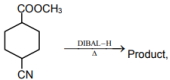
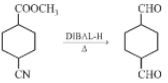
Product is :
- A

- ✓

- C

- D

Generate a complete, print-ready paper with questions like this in minutes — across 16+ boards, with answer keys.
$(i)$ $N{O_2}\xrightarrow{{slow}}NO + O$
$(ii)$ ${F_2} + O + NO\xrightarrow{{Fast}}N{O_2}F + F$
$(iii)$ $F + N{O_2}\xrightarrow{{Fast}}N{O_2}F$
Select the correct one
| Column $I$ | Column $II$ |
| $(A)$ $\mathrm{O}_2^{-} \rightarrow \mathrm{O}_2+\mathrm{O}_2{ }^{2-}$ | $(p)$ redox reaction |
| $(B)$ $\mathrm{CrO}_4{ }^{2-}+\mathrm{H}^{+} \rightarrow$ | $(q)$ one of the products has trigonal planar structure |
| $(C)$ $\mathrm{MnO}_4^{-}+\mathrm{NO}_2^{-}+\mathrm{H}^{+} \rightarrow$ | $(r)$ dimeric bridged tetrahedral metal ion |
| $(D)$ $\mathrm{NO}_3^{-}+\mathrm{H}_2 \mathrm{SO}_4+\mathrm{Fe}^{2+} \rightarrow$ | $(s)$ disproportionation |
$(I)$ Acid chloride $(II)$ Aldehyde
$(III)$ Ketone $(IV)$ Ester
Select the correct answer from the codes given below :
$\left[\mathrm{CoCl}\left(\mathrm{NH}_3\right)_5\right]^{2+}, \quad\left[\mathrm{Co}(\mathrm{CN})_6\right]^{3-} \text {, }$
$(A)$ $(B)$
$\left[\mathrm{Co}\left(\mathrm{NH}_3\right)_5\left(\mathrm{H}_2 \mathrm{O}\right)\right]^{3+}, \quad\left[\mathrm{Cu}\left(\mathrm{H}_2 \mathrm{O}\right)_4\right]^{2+}$
$(C)$ $(D)$
The correct order of $A$, $B$, $C$ and $D$ in terms of wavenumber of light absorbed is :