MCQ
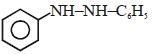
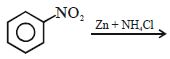
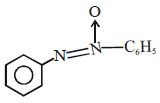
Product is
  • A


  • C

  • D
    $C_6H_5-N=N-C_6H_5$

Answer

Correct option: B.

b

Need a full question paper?

Generate a complete, print-ready paper with questions like this in minutes — across 16+ boards, with answer keys.
Start Generating Free

Similar questions

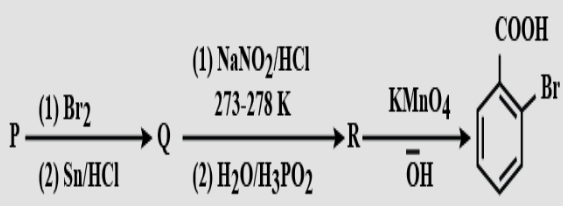
In the sequence of the given reactions, the starting compound P is:

For conversion of compound $A \rightarrow B$, the rate constant of the reaction was found to be $4.6 \times 10^{-5}\,L\, mol ^{-1}\, s ^{-1}$. The order of the reaction is $..........$ 
Number of ions present in ${K_4}[Fe{(CN)_6}]$
Mutation of $DNA$ occurs due to changes in the sequence of one of the following
Transition metals show paramagnetism
For a first order reaction $\mathrm{A} \rightarrow \mathrm{P}$, the temperature ( $\mathrm{T}$ ) dependent rate constant ( $k$ ) was found to follow the equation $\log k=-(2000) \frac{1}{\mathrm{~T}}+6.0$. The pre-exponential factor $\mathrm{A}$ and the activation energy $\mathrm{E}_{\mathrm{a}}$, respectively, are
An aqueous solution of hydrazine $\left( N _2 H _4\right)$ is electrochemically oxidized by $O _2$, thereby releasing chemical energy in the form of electrical energy. One of the products generated from the electrochemical reaction is $N _2( g )$.

Choose the correct statement($s$) about the above process

$(A)$ $OH ^{-}$ions react with $N _2 H _4$ at the anode to form $N _2( g )$ and water, releasing 4 electrons to the anode.

$(B)$ At the cathode, $N _2 H _4$ breaks to $N _2( g )$ and nascent hydrogen released at the electrode reacts with oxygen to form water.

$(C)$ At the cathode, molecular oxygen gets converted to $OH ^{-}$.

$(D)$ Oxides of nitrogen are major by-products of the electrochemical process.

Which of the following is an example of homoleptic complex?
For the non-stoichiometric reaction $2A + B \to C + D,$ the following kinetic data were  obtained in three separate experiments, all at $298\,K$.

Initial Conc.
 $(A)$
Initial Conc.
 $(B)$

Initial rate of
formation of $C\,(mol\, L^-S^-)$

$0.1\,M$ $0.1\,M$ $1.2 \times 10^{-3}$
$0.1\,M$ $0.2\,M$ $1.2 \times 10^{-3}$
$0.2\,M$ $0.1\,M$ $2.4 \times 10^{-3}$

For the reaction the rate of formation of $C$ will be

Which one is not synthesized by Grignard reagent