MCQ
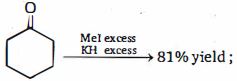
Product of the reaction is
  • A

  • B


  • D

Answer

Correct option: C.

c

Need a full question paper?

Generate a complete, print-ready paper with questions like this in minutes — across 16+ boards, with answer keys.

Start Generating Free

Similar questions

$\underset{(d)}{\mathop{\begin{matrix}
   C{{H}_{3}}-CH-OAc  \\
   |  \\
   Et  \\
\end{matrix}}}\,$ $\xrightarrow{H{{O}^{-}}}$ ( $d=$ dextro rotatory)  Product of the reaction is
The conversion of acetophenone into benzoic acid can be achieved by its reaction with
Given below are two statements:

Statement $I$: The boiling point of hydrides of Group $16$ elements follow the order

$\mathrm{H}_2 \mathrm{O}>\mathrm{H}_2 \mathrm{Te}>\mathrm{H}_2 \mathrm{Se}>\mathrm{H}_2 \mathrm{~S}$.

Statement $II$: On the basis of molecular mass, $\mathrm{H}_2 \mathrm{O}$ is expected to have lower boiling point than the othe members of the group but due to the presence of extensive $\mathrm{H}$-bonding in $\mathrm{H}_2 \mathrm{O}$, it has higher boiling point.

In the light of the above statements, choose the correct answer from the options given below:

The reactions of $Cl _2$ gas with cold-dilute and hot-concentrated $NaOH$ in water give sodium salts to two (different) oxoacids of chlorine, $P$ and $Q$, respectively. The $Cl _2$ gas reacts with $SO _2$ gas, in presence of charcoal, to give a product $R$. $R$ reacts with white phosphours to give a compound $S$. On hydrolysis, $S$ gives an oxoacid of phosphours $T$

$1.$ $P$ and $Q$, respectively, are the sodium salts of

$(A)$ hypochlorus and chloric acids

$(B)$ hypochlorus and chlorus acids

$(C)$ chloric and perchloric acids

$(D)$ chloric and hypochlorus acids

$2.$ $R , S$ and $T$, respectively, are

$(A)$ $SO _2 Cl _2, PCl _5$ and $H _3 PO _4$

$(B)$ $SO _2 Cl _2, PCl _3$ and $H _3 PO _3$

$(C)$ $SOCl _2, PCl _3$ and $H _3 PO _2$

$(D)$ $SOCl _2, PCl _5$ and $H _3 PO _4$

Give the answer question $1$ and $2.$

Which of the following has maximum boiling point ?
$C_6H_6$ $\xrightarrow[AlC{{l}_{3}}]{\begin{matrix}
   \,\,\,\,\,\,\,\,\,\,\,\,\,\,\,\,\,\,O  \\
   \,\,\,\,\,\,\,\,\,\,\,\,\,\,\,\,\,\,||  \\
   {{(C{{H}_{3}})}_{2}}CH-C-Cl  \\
\end{matrix}}$  $\xrightarrow[reduction]{Clemmensen}$  $\xrightarrow[AlC{{l}_{3}}]{\begin{matrix}
   \,\,\,\,\,\,\,\,\,\,\,\,\,\,\,\,\,\,\,\,\,\,\,O\,\,\,\,\,\,\,\,\,\,\,\,\,\,\,\,\,  \\
   \,\,\,\,\,\,\,\,\,\,\,\,\,\,\,\,\,\,\,\,\,\,\,\,||\,\,\,\,\,\,\,\,\,\,\,\,\,\,\,\,\,\,  \\
   C{{H}_{3}}-C-Cl  \\
\end{matrix}}$ $\xrightarrow[{{H}_{3}}{{O}^{\oplus }}]{\operatorname{Re}d\,\,\,P\,+\,HI}$ (Ibuprofen)

Ibuprofen is 

The reaction taking place at the anode in lead accumulator cell is :
Bullet-proof steel alloy is prepared by using
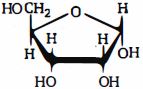
Which of the following represents the anomer of the compound shown ?
$2\,g$ of benzoic acid ( $M_w = 122\,g/mol$ ) dissolve in $25\,g$ $C_6H_6$ and shows a depression in freezing point equal to $1.62\,K,$ $K_f (C_6H_6) = 4.9\,K\,molal^{-1}$ if acid forms dimer in solution then the percentage association of acid is  ......... $\%$.